Showing posts with label human rights. Show all posts

March 12, 2009

What I've been doing lately

Paper writing. It seems to almost be all that I do these days.

Since the beginning of the term, this is what I have produced:
  • History in Tony Kushner's Angels in America: Millenium Approaches, or the quest for a sexual or a historical identity ;
  • A reflection on the development of the Northumbrian dialect between the 8th and the 12th century ;
  • Bartleby the Scrivener: an evocation of the Statue of Liberty ;
  • A detailed analysis of Ronsard's 9th Sonnet to Hélène, or the protrayal of a love duel ;
  • Béroul's Tristan & Isolde, the symbolism of the Mal Pas, or the farce which allows to reintegrate the social space.

I also have the following assignments to produce over the coming weeks:

  • A lexicographic analysis of three semantically related words ;
  • Madness and marriage in Virginia Woolf's Mrs. Dalloway and Charlotte Gilman's The Yellow Wallpaper ;
  • A study of the mutual influences of the French and English languages one on another.

There is one more larger essay for which I need to pick my topic, but it isn't due for a bit, so I do have time to decide.

Ah, woe is me. I do enjoy what I'm doing, though. I'll post excerpts when I can get to editing the raw bits.

Even if so far, I'm doing extremely well with my work.

The Beaver
My guest map is wonderful ! And you'd all be wonderful to post, all of you lurk mode readers!
Thanks and may the winds of Fate blow your way !

February 18, 2007

Beaver visits the simple path (Threading in the footsteps of an icon is also part of the game)

Upcoming posts:
- the super-power of complaining
- Gandhi's Ashram - the pearl of Ahmedabad

The last night before I left Kolkata, I had the immense honor of being introduced to the Missionaries of Charity's motherhouse and to their working grounds.

Of the ignoramus reading this, the Missionaries of Charity are the order of nun, brothers, and lays that was founded by Mother Theresa. If you come from Mars and don't know who Blessed Mother Theresa is (or if you are from Earth and curious to know more about her life), click here.

Again, I was out of battery when I went, so I had to rely on Google to "borrow" some illustrations.

We started off by going to the house of Mother Teresa, and pay our respects to her tomb.

When one enters the home of the missionaries of Charity, there is a strong sense of peace and devotion. Anyone can only be humbled by the generosity and the dedication of the M.O.C. Just to see how dedicated one must be to be a M.O.C... here is the path they must take.
  • Aspirancy--6 months.

  • Postulancy--Up to 1 year.

  • Novitiate--2 years. First vows are taken after this.

  • Juniorate--5 years. Vows are renewed each year.

  • Tertianship--The 6th year of vows, after which final vows are taken.

Once the full vows are taken, the newly hatched M.O.C. can visit her family for 2 weeks, every NINE YEARS !!! That's some dedication for you !

Once we were done, we were allowed to see Mother Teresa's room, although pictures were not to be taken. It was a simple, humble and very small room with a sober bed, table and chair. A crucifix adorned the room. Nothing schocking from the woman who adopted the simple path.

THE SIMPLE PATH

The fruit of silence is PRAYER.

The fruit of prayer is FAITH.

The fruit of faith is LOVE.

The fruit of love is SERVICE.

The fruit of service is PEACE.

Once that was done, we visited the largest orphanage in Kolkata, where we met the children that are fostered by the M.O.C. It was just rooms and rooms full of children, babies, toddlers, boys and girls, healthy, ill, handicapped, happy, sad, indifferent, but all lively and beautiful because so full of life.

In one of the rooms, a little boy, maybe 18 months old, took a liking to me. He would just talk to me, and thrown his arms open at me. Most of the children I met were eager to be held, curious of my difference, and expressing a very important need: love.

I fell in love and got my heart broken countless times that night. I wanted to leave everything and adopt as many of these little ones as I could. I wanted to give them a home. But quitting would have made giving them a home difficult, aside from the fact that I am a gipsy at that moment. I don't even have a trailer !!!

The Beaver

My guest map is wonderful ! And you'd all be wonderful to post, all of you lurk mode readers!
Thanks and may the winds of Fate blow your way !

February 03, 2007

In my last life, I was....

THERE IS A MOVIE HIDDEN IN THIS VERY VERY LONG UPDATE.
THERE ARE ALSO PICTURES AND A FUN TEST TO TAKE !

Otherwise, be patient and hear about my field trips to North and West Bengal from these last two weeks...

For West Bengal pics click here.
For North Bengal pics, click here.


The whole thing was an ordeal to be honest. It started on Sunday - my colleague (let's call her June) and my 2 local counterparts (let's call them Bob and Patel) drove to the Kolkatta airport to catch our flight to the Bagdrogra air base.

Of course, nothing ever is THAT simple. So it started off with us having to wait an extra hour, with me undergoing a particularly thorough security check (oh boy do I hate those). We finally got on the plane, which took off. Everything seemed to be going well (at least this time I had made the flight) - but my proverbial bad karma caught up with us.

The poor landing conditions in Bagdogra - apparently there was too much fog - scared the pilot. He turned the plane around after having hovered over the base for 2 hours (it's typically a one-hour flight) and took us back to KOL. By the time we deplaned, found a car, underwent the long drive back with the mandatory 5 long stops in traffic, I got back to the hotel, disgruntled and disgusted that I had lost a sunday afternoon in KOL for no good reason.

Anyway, the next day we tried again and succeeded. I count myself lucky because some people had been trying to get to Bagdogra since Saturday!

Upon arrival, we greeted the staff of the office and even had a long sit-down with the local Bishop. That man made a memorable impression on me. Such a lovely person, well spoken, invested in his diocese, and so very aware of the local issues. I will remember our conversations very fondly. Some topics that were touched on:
- Elephants are a nuisance in North Bengal. One even disturbed an outside service, sending the priest to run for his life !
- The main livelyhood in the area is the famous tea gardens which produce the well known Darjeeling tea. Most of these tea gardens are owned by private owners and the conditions of the workers (most of which are form the Ranshi area) are not in conformity with international labor standards. Additionnaly, their income is directly tied to the productivity of the garden - so they are the first to suffer from the weather's inconsistencies.

Tea Garden

Basically, I was going there to meet with our local counterparts and evaluate their systems. As part of my work, a whole day was spent out in the field visiting the small local organizations who actually channel the ressources (in this case, the food) to the people it is destined to (in this case, children from the tea garden families.) The first place I went to was Julilee Memorial School - the children were, of course, absolutely beautiful. They also were very shy since they had never met a foreigner before. After a shortwhile, they loosened up though, as you can see here :

Saint Francis' School 2

The children also presented their Indendence Day program which I filmed... so here it is !


The second school I went to was actually an orphanage. I visited the facilities and met the children. They were also very shy, but the group picture I took seemed to really have made their day :


Don Bosco School 12

It was very touching - but also saddening because the public agency that is currently feeding these kids is ending the program in four years. And when you see the children and their caregivers, you do understand that the need is not going to go away in only 4 years.

Thankfully, there was, again, a beautiful sunset to soothe my soul on the way back:

Crematorium at Sunset

At the hotel, an alternate reality was waiting for me. The Sao Paolo soccer team was staying on my floor ! It was like living in a Brazilian dorm !
Soccer Giants

I got back to Kolkata just on time to go out with June for dinner - but not before i got the famous Mohindi tatoo done !

India 044

That feeling was intensified this week after I visited two other schools in the Baruipur region (in West Bengal). They were much poorer than those I visited in the North. Both schools were in fact nurseries, and again I had a chance to meet the beautiful children who attend at the first one:
Children at lunch - Kearakali Jana Sevashram

Because it took us too long to reach the second school, the survey team actually got there after the children went home, but the teachers were waiting for us and gave me a presentation of their teaching techniques. All the teachers are mothers who have children in school and reconverted to teaching.
Teacher Demo - Nimpith Tulshighata Netaji Sangha

Although the schools were very poor, it was so touching to see how the teachers had really invested in creating activities and materials to really engage the children in their learning process. It was also very appeasing to to see the Bengali countryside and village scenes.

Now I'm back in Kolkata and slowly coming back to my normal state. The daily drives to Baruipur have, I must admit, really taken their toll on me....

==========================================

Now for the big reveal :

In my last life, I was...........

A Friendly Alien

You scored 36 alien-ness, 28 mythical-ness, 52 angelic-ness, and 16 regal-ness!

Have you ever seen the Steven Speilburg film E.T? You also are a gentle being from another planet, where you have spent most of your previous incarnations. The strife and violence on earth hurts you. Your only wish is goodwill and kindness to mankind. You have a talent for healing - both plants and animals - and should consider some study in this area.

At best you were gentle, gracious and radient.

At worst you were indescive, aloof and clumsy.

In this lifetime you have gifts of diplomacy you should put into use! You'd be wonderful at running a country but are too gentle to promote yourself in election. Be assertive. You're a lovely human being.


This test tracked 4 variables. How the score compared to the other people's:
Link: The PREVIOUS INCARNATION Test written by Fyrdancer on Ok Cupid

The Beaver


My guest map is wonderful ! And you'd all be wonderful to post, all of you lurk mode readers!
Thanks and may the winds of Fate blow your way !

November 13, 2006

Speak out !

I uploaded some new beautiful pics of the Carribean Sea - just click on the side bar Flickr badge to see them. There are some fun stories to tell about snorkling and sailing, but for now I want to talk some more about the fight against intolerance and what we can do to help. It's not only about seeing a movie. It's mostly about doing what is right, and building a better place.

This all started with The Laramie Project. I posted some more about it just HERE.

The man who got brutally killed and tortured in Laramie because he was different was Matthew Sheppard. It happens I didn't know him - but that doesn't matter because next time it could be my friend or my relative. It could also be yours. The mobile of his vile murder was HATE. It was in 1998, and it's still happening.

I just checked the state in which I spend the most time (Maryland), and was appalled to find out that there are 7 hate groups in the state, 4 of them being based on Baltimore. To me, that's a major eye-opener.

*Although the Southern Poverty Law Center recognizes that much black racism in America is, at least in part, a response to centuries of white racism, it believes racism must be exposed in all its forms. White groups espousing beliefs similar to Black Separatists would be considered clearly racist. The same criterion should be applied to all groups regardless of their color.

If you want to check out what is going on in your state, click HERE.

I have gay friends and relatives. I have friends from all ethnicities. Because I love them, this concerns me. I have been around the world enough to know that this issue concerns us all. So I took the PLEDGE TO SPEAK OUT, and I encourage you all to take it as well, no matter who you are, where you come from, what your background is. We are all in this together.

I am reproducing it for your information, and thus am reiterating my wow to speak out against intolerance and bias.

I, the Travelling Beaver, will:

  • Speak up when I hear or see bigotry;
  • Question and identify bias when I see it;
  • Be mindful of my own behaviors;
  • Promote and appeal to higher principles;
  • Set limits on what is said or done around me;
  • Seek help and help others to work against bigotry; and
  • Remain vigilant and persistent.
Intolerance must be fought, because it affects all of us.

For more information visit Tolerance.Org

If you know of other organizations that partake in such campaigns, let me know and i will also list them here for referrence.

The Beaver

Speak out !

November 12, 2006

Parentheses

I have plenty to tell about last night and today.... for I want to set my frivolities aside tonight and talk to you, gentle reader, about something important to me.

I just finished seeing this movie and felt I should immediately share it. This is moving, disturbing, and necessary. We all have a conscience. The Laramie Project reminds us that tolerance is an ongoing fight and explores the deep confines of what I can only refer to as collective guilt.


"The brutal attack on Matthew Shepard was the kind of wakeup call a society doesn't get very often. It triggered an avalanche of media, a kind of national deathwatch until Shepard died five days later. THE LARAMIE PROJECT is the response of one man, playwright Moisés Kaufman, and his colleagues at the Tectonic Theater Project, who went to Laramie, Wyoming, and conducted more than 200 interviews with townspeople and officials. The result is this inquiry into hate and the thoughts and feelings of an American community. As one local states, Laramie became instantly notorious, "like Waco or Jasper." But The Laramie Project is not an exercise in self-righteous condemnation. It merely attempts to come to terms with what happened. It's a film, based on the play by the troupe, that presents the details of the slaying as revealed by those closest to it, and the truth lies in the details. It's a film about homophobia across the nation, but as one woman deftly points out, "Honey, it's still about Laramie."

It was Matthew Sheppard, but it could have been my friend or my relative. It could also be yours.

For more information visit Tolerance.Org

The Beaver

My guest map is wonderful ! And you'd all be wonderful to post, all of you lurk mode readers!
Thanks and may the winds of Fate blow your way !

July 23, 2006

Horror and Shame

Below is my personal take in a discussion that has been going on here.

Steven Harper, our conservative prime minister, newly elected in December 05, has been brown nosing with Dubya ever since. With now confirmed rumors that the US are participating in the Israeli attack plan, more and more canadians feel that Harper has broken the image of neutrality and tolerance that Canada usually has across the world.

Moreoever, his evacuation plan moves at snail pace, and he has NOT taken action since some Lebenase-born Canadian citizens have been killed in the attacks.

There are rumors that we will go in election mode again in the fall to get rid of this useless politician, and Canadians are down in the street to express their discontent.

My word is this: if your government is supporting the Israeli attack, go in the street and support the protest efforts.

If you are an American citizen, consider your options. The Democrats are not disapproving the Republican support to Israel, which I guess means a third road is starting to be PARAMOUNT.

As far as I'm concerned, if Canada remains conservative, it's likely that I will join the soveignist cause in Quebec or move to France. I have no interest in being affiliated with Harper's support to the massacre of innocents.


The Beaver

My guest map is wonderful ! And you'd all be wonderful to post, all of you lurk mode readers!
Thanks and may the winds of Fate blow your way !

May 21, 2006

Conundrum

Recently, I've been faced with a moral dilemna. Out of personnal interest, I visited an orphanage.

If you're not familiar with humanitarian or charity action, here's a vital piece of information you need to know: money does not grow on trees. And institutions face that reality every day.

The moral dilemna I face is this one:

In Haiti, street kids are a common sight. These kids' life conditions on the streets are anything but safe. They starve, get beaten, raped and otherwise abused. In the process, these kids contract all sorts of STD, including (and particularly) HIV/AIDS. And, of course, they have nowhere safe to sleep at night.

These children are faced with a limited set of options:

1) Stay on the street. Endure. Survive the horror.

2) Go home. Some of these kids actually have a home to go to. It's just that their parents can't feed them, or abuse them.

3) Go to a kid shelter.

The kid shelter I visited had the advantage of offering a safe place to stay at night and access to education.

However, when I visited the orphanage, this is what I saw:

1) Hygiene conditions were *unbearable*, as I couldn't even inspect the toilets because of the *stench*;

2) Sleeping conditions for the children were uncertain. Although the kids claim they share a bed (at three in a child crib), and bed sheets were DIRTY apparently full of coodies;

3) The children are homeschooled. Cool! But they were sleeping on their desks - I think they hadn't eaten in 24 hours. I found out late that to make matters worse, a caregiver had been stealing food from the children.

4) A little boy, maybe 6 years of age and obviously sick since several days, had not received any care at all. He was feverish, so when I asked the care-giver what she would give him, she claimed she would give a 6 year old boy some medication for children aged 0 to 24 months!

Interestingly enough, the manager of the center was outraged of these observations, which makes me thinks she hadnt visited the place in a long, long time. She fired the theiving caregiver on the spot, and assured me that she would fix the other problems, but I'm sceptical. To me, the main problem was ignorance and lack of education that led to utter and complete child neglect. Given that these people have already been trained by a competent Haitian care-giver, I wonder WHAT ELSE CAN BE DONE ?

One of my friends visited a similar orphanage, where the conditions were worsened by the fact that the center's manager was abusing the children.

"There are an estimated 1.2 million orphans and at-risk children in Haiti. That's approximately 15-20% of the country's total population! Over 200,000 children live in orphanages or institutionalized group settings that do not meet the minimum standards of child care." (Statistics from At Risk Children Foundation)

This makes me wonder. Are the kids still better off in a center, or on the streets?

The Beaver

Thanks, Michelino en France, for posting on my guestmap! My guest map is wonderful ! And you'd all be wonderful to post, all of you lurk mode readers!
Thanks and may the winds of Fate blow your way !

March 23, 2006

About Liberia and Sierra Leone

I'd been meaning to do this in a while. A little bit more about the Country I am currently visiting. Thanks to WIKIPEDIA for a very exhaustive article.

The Republic of Liberia is a country on the west coast of Africa, bordered by Sierra Leone, Guinea, and Côte d'Ivoire. It has recently been afflicted by two civil wars, the Liberian Civil War (19891996), and the Second Liberian Civil War (19992003), that have displaced hundreds of thousands of its citizens and destroyed the Liberian economy.

Settlers from America

The history of Liberia as a political entity begins with the arrival of the black American settlers — the Americo-Liberians, as they came to be known — who established a colony of “free men of color” on its shore in 1822 under the auspices of the American Colonization Society. The historical roots from which a majority of present-day Liberians derive their identity, however, are found in the varied traditions of the several ethnicities of indigenous Africans whom the settlers confronted in their struggle to gain a foothold in Africa and, later, extend their control into the interior.

On July 26, 1847, the American settlers declared the independence of the Republic of Liberia. The settlers regarded the continent from which their forefathers had been taken as slaves as a "Promised Land", but they did not become reintegrated into an African society. Once in Africa, they referred to themselves as "Americans" and were recognized as such by local Africans and by British colonial authorities in neighboring Sierra Leone. The symbols of their state — its flag, motto, and seal — and the form of government that they chose reflected their American background and diaspora experience.

President Edwin Barclay of Liberia (right), 1943
Enlarge
President Edwin Barclay of Liberia (right), 1943

The religious practices, social customs and cultural standards of the Americo-Liberians had their roots in the antebellum American South. These ideals strongly coloured the attitudes of the settlers toward the indigenous African people. The new nation, as they perceived it, was coextensive with the settler community and with those Africans who were assimilated into it. Because of mutual mistrust and hostility between the "Americans" along the coast and the "Natives" of the interior, a recurrent theme in the country's subsequent history, therefore, was the usually successful attempt of the Americo-Liberian minority to dominate people whom they considered uncivilized and inferior. They named the land "Liberia," which in European languages, and in Latin in particular, means "Land of the Free".

Stephen Allen Benson, President of Liberia 1856-1864
Enlarge
Stephen Allen Benson, President of Liberia 1856-1864

The founding of Liberia was privately sponsored by American religious and philanthropic groups, but the colony enjoyed the support and unofficial cooperation of the United States government. Liberia’s government, modeled after that of the United States, was democratic in structure, if not always in substance. After 1877 the True Whig Party monopolized political power in the country, and competition for office was usually contained within the party, whose nomination virtually ensured election. Two problems confronting successive administrations were pressure from neighboring colonial powers, Britain and France, and the threat of financial insolvency, both of which challenged the country’s sovereignty. Liberia retained its independence during the Scramble for Africa, but lost its claim to extensive territories that were annexed by Britain and France. Economic development was retarded by the decline of markets for Liberian goods in the late nineteenth century and by indebtedness on a series of loans, payments on which drained the economy.

William R. Tolbert, Jr.. (left), President of Liberia, 1973
Enlarge
William R. Tolbert, Jr.. (left), President of Liberia, 1973

Significant mid-20th-century events

Two events were of particular importance in releasing Liberia from its self-imposed isolation. The first was the grant in 1926 of a large concession to the American-owned Firestone Plantation Company; that move became a first step in the modernization of the Liberian economy. The second occurred during World War II, when the United States began providing technical and economic assistance that enabled Liberia to make economic progress and introduce social change.

1980 coup under Doe

On 12 April 1980, a successful military coup was staged by a group of noncommissioned officers of tribal origins led by Master Sergeant Samuel Kanyon Doe, and they executed the President of nine years William R. Tolbert, Jr. in his mansion. Constituting themselves the People’s Redemption Council, Doe and his associates seized control of the government and brought an end to Liberia’s "first republic".

President Tolbert with American president Carter in Monrovia, 1978
Enlarge
President Tolbert with American president Carter in Monrovia, 1978

Doe made strong ties with the United States in the early 1980s, receiving more than $500 million for pushing out the Soviet Union from the country, and allowing exclusive rights for the US to use Liberia's ports and land (including allowing the CIA to use Liberian territory to spy on Libya).

Doe continued his authoritarian policies, banning newspapers, outlawing opposition parties and holding staged elections.

1989 and 1999 civil wars

In late 1989, a civil war began, and in September 1990 Doe was ousted and killed by the forces of faction leader Yormie Johnson and members of the Gio tribe. As a condition for the end of the conflict, interim president Amos Sawyer resigned in 1994, handing power to the Council of State. Prominent warlord Charles Taylor was elected as President in 1997. Taylor's brutal regime targeted several leading opposition and political activists. In 1998, the government sought to assassinate child rights activist Kimmie Weeks for a report he had published on its involvement in the training of child soldiers, which forced him into exile. Taylor's autocratic and dysfunctional government led to a new rebellion in 1999. More than 200,000 people are estimated to have been killed in the civil wars. The conflict intensified in mid-2003, when the fighting moved closer to Monrovia. As the power of the government shrank and with increasing international and American pressure for him to resign, President Charles Taylor accepted an asylum offer by Nigeria, but vowed: "God willing, I will be back."


October 15, 2005

About ( A propos de) The Republic of Guinea

(French and English alternate in the text)
(Francais et anglais intercales dans le texte)

Readers, you have been heard, and I will post more about my professional activities... but this post was already in the making, so here it is! It will also give you insights about the atmosphere and the things I may or may not have to deal with.

Lecteurs, vous avez été entendu, et j'ecrirais plus au sujet de mes activités professionnelles... mais ce post était déjà presque ecrit, donc le voila ! Il vous donnera également une idee de l'atmosphère du pays ou je travaille et de choses avec lesquelles je dois composer... ou non !
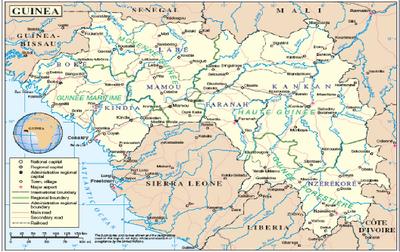


"History & Politics / Histoire & politique
The area occupied by Guinea today was included in several large West African political groupings, including the Ghana, Mali, and Songhai empires, at various times from the 10th to the 15th century, when the region came into contact with European commerce. Guinea's colonial period began with French military penetration into the area in the mid-19th century. French domination was assured by the defeat in 1898 of the armies of Almamy Samory Touré, warlord and leader of Malinke descent, which gave France control of what today is Guinea and adjacent areas.

Le secteur occupé par Guinea aujourd'hui a été inclus dans plusieurs grands groupements politiques africains occidentaux, y compris les empires du Ghana, du Mali, et du songhai, à de diverses heures de la 10ème au 15ème siècle, quand la région a entré en contact avec le commerce européen. La période coloniale de la Guinée a commencé par la pénétration militaire française dans le secteur en siècle de mid-19th. La domination française a été assurée par la défaite dans 1898 des armées d'Almamy Samory Touré, seigneur de la guerre et chef de descente de Malinke, qui a donné la commande de la France de ce qui est aujourd'hui Guinée et secteurs adjacents.

France negotiated Guinea's present boundaries in the late 19th and early 20th centuries with the British for Sierra Leone, the Portuguese for their Guinea colony (now Guinea-Bissau), and the Liberia. Under the French, the country formed the Territory of Guinea within French West Africa, administered by a governor general resident in Dakar. Lieutenant governors administered the individual colonies, including Guinea.

Les frontières actuelles de la Guinée négociée par la France vers la fin de la 19ème et les début du 20ème siècles avec les Anglais sont la Sierra Leone, les Portugais pour leur colonie de Guinée (maintenant Guinée-Bissau), et le Libéria. Sous les Français, le pays a formé le territoire de la Guinée dans l'Afrique occidentale française, administré par un résidant général de gouverneur à Dakar. Les gouverneurs de lieutenant ont administré les différentes colonies, y compris la Guinée.
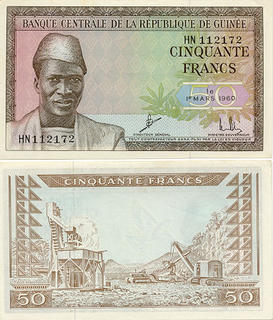
Led by Ahmed Sékou Touré, head of the Democratic Party of Guinea (PDG), which won 56 of 60 seats in 1957 territorial elections, the people of Guinea in a September 1958 plebiscite overwhelmingly rejected membership in the proposed French Community. The French withdrew quickly, and on October 2, 1958, Guinea proclaimed itself a sovereign and independent republic, with Sékou Touré as president.

Mené par Ahmed Sékou Touré, tête du parti démocratique de la Guinée (PDG), qui a gagné 56 de 60 sièges dans 1957 élections territoriales, les personnes de la Guinée dans un plébiscite de septembre 1958 ont primordialement rejeté l'adhésion dans la Communauté française proposée. Français s'est retiré rapidement, et sur octobre 2, 1958, la Guinée s'est proclamée une république souveraine et indépendante, avec Sékou Touré comme président.
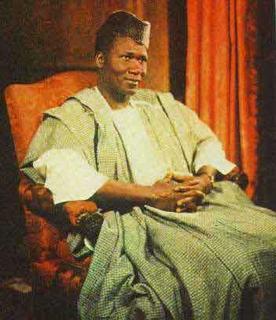
Under Touré, Guinea became a one-party state, with a closed, socialized economy and no tolerance for human rights, free expression, or political opposition, which was ruthlessly suppressed. The regime's repression drove more than a million Guineans into exile, and Touré's paranoia ruined relations with foreign nations, including neighboring African states, increasing Guinea's isolation and further devastating its economy. Sékou Touré and the PDG remained in power until his death on April 3, 1984, when a military junta headed by then-Lt. Col. Lansana Conte seized power.

Sous Touré, la Guinée est devenue un état unipartite, avec une économie fermée socialiste et aucune tolérance pour des droits de l'homme, la libre expression, ou l'opposition politique, qui etaient été impitoyablement supprimés. La répression du régime a conduit plus d'un million de Guinéens dans l'exil, et la paranoïa de Touré a ruiné des relations avec des nations étrangères, y compris les Etats africains voisins, augmentant l'isolement de la Guinée et dévastant son économie. Sékou Touré et le PDG est resté au pouvoir jusqu'à sa mort le 3 avril 1984, quand une elite militaire dirigee par l'alors-Lieutenant. Colonnel Lansana Conte a pris le pouvoir.
The Military Committee of National Recovery (CMRN) took control of Guinea in April 1984, just one week after the death of independent Guinea's first president, Sékou Touré. The CMRN announced its intention to liberalize the economy, promote private enterprise, and encourage foreign investment in order to develop the country’s rich natural resources. The CMRN formed a transitional parliament which created a new Constitution (La Loi Fundamental) and Supreme Court in 1990. The country’s first multi-party presidential election took place in 1993. These elections were reportedly marred by irregularities and lack of transparency on the part of the government. Legislative and municipal elections were held in 1995. Conte’s ruling PUP party won 76 of 114 seats in the National Assembly, amid opposition claims of irregularities and government tampering. The new National Assembly held its first session in October 1995.

Le Comité militaire du rétablissement national (CMRN) a pris les commandes de la Guinée en avril 1984, juste une semaine après la mort du premier président de la Guinée indépendante, Sékou Touré. Le CMRN a annoncé son intention de libéraliser l'économie, de favoriser l'entreprise privée, et d'encourager l'investissement étranger afin de développer les ressources naturelles riches du pays. Le CMRN a formé un parlement transitoire qui a créé une nouvelle constitution (principe fondamental de Loi de La) et la cour suprême en 1990. La première élection présidentielle multi-partis du pays a eu lieu en 1993. Ces élections ont été censément troublées par des irrégularités et manque de transparent de la part du gouvernement. Des élections législatives et municipales ont été tenues en 1995. La partie régnante du PUP de Conte a gagné 76 de 114 sièges dans l'Assemblée nationale, parmi des réclamations d'opposition des irrégularités et du gouvernement trifouillant. La nouvelle Assemblée nationale a tenu sa première session en octobre 1995.

Several thousand malcontent troops mutinied in Conakry in February 1996, destroying the presidential offices and killing several dozen civilians. Mid-level officers attempted, unsuccessfully, to turn the rebellion into a coup d’etat. The Government of Guinea made hundreds of arrests in connection to the mutiny, and put 98 soldiers and civilians on trial in 1998.

Plusieurs milliers de troupes mécontentes se sont révoltées à Conakry en février 1996, détruisant les bureaux présidentiels et tuant plusieurs douzaines de civils. Les officiers intermediaires ont essayé, sans succès, de transformer la rébellion en coup d'état. Le gouvernement guineen a fait des centaines d'arrestations liees à la révolte, et 98 soldats et civils furent traduits en justice en 1998.

In December 1998, Conté was re-elected to another 5-year term. Following his reelection and the improvement of economic conditions through 1999, Conté reversed direction, making wholesale and regressive changes to his cabinet, which have led to increased cronyism, corruption, and a retrenchment on economic and political reforms.

En décembre 1998, Conté a été réélu pour un autre mandat de cinq ans. Après sa réélection et l'amélioration des conditions économiques par 1999, Conté a renversé la direction, faisant en gros et les changements régressifs dans son coffret, qui ont mené a une augmentation du cronyism, à la corruption, et à un retranchement sur des réformes économiques et politiques.

Beginning in September of 2000, the Revolutionary United Front (RUF) rebel army, backed by Liberian President, Charles Taylor, commenced large-scale attacks into Guinea from Sierra Leone and Liberia. The RUF, known for their brutal tactics, in the near decade-long civil war in Sierra Leone, operated with financial and material support from the Liberian government and its allies. These attacks destroyed the town of Gueckedou as well as a number of villages, causing large-scale damage and the displacement of tens of thousands of Guineans from their homes. The attacks also forced the UNHCR to relocate many of the 200,000 Sierra Leonean and Liberian refugees residing in Guinea.

Commençant en septembre de 2000, le Revolutionary United Front (RUF), soutenu par le Président liberien , Charles Taylor, a commence, du Sierra Leone et du Libéria, des attaques de grande échelle en Guinée. Le RUF, connu pour leur tactique brutale, dans la guerre civile de dix ans en Sierra Leone, actionnée avec l'appui financier et matériel à partir du gouvernement libérien et de ses alliés. Ces attaques ont détruit la ville de Gueckedou aussi bien qu'un certain nombre de villages, entraînant des dommages à grande échelle et le déplacement des dizaines de milliers de Guinéens de leurs maisons. Les attaques ont également forcé l'UNHCR a replacer plusieurs des 200.000 Sierra-Léonais et de réfugiés libériens résidant en Guinée.

After the initial attacks in September 2000, President Conté accused Liberian and Sierra Leonean refugees living in the country of fomenting war against the government. Soldiers, police, and civilian militia groups rounded up thousands of refugees. Approximately, 3,000 refugees were detained, although most were released by year’s end.

Après les attaques initiales en septembre 2000, le Président Conté a accuse les réfugiés Libériens et Sierra-Léonais vivant dans le pays de la guerre de conspiration contre le gouvernement. Les soldats, la police, et les groupes civils de milice ont traque des milliers de réfugiés. Approximativement, 3.000 réfugiés ont été détenus, bien que les la plupart aient été libérées a la fin de l'annee.

In December 2003 Conte was re-elected for a third term, after having had the presidential mandate extended two years earlier. In early 2004 a newly appointed prime minister resigned while out of the country in Paris. Thereafter, followed a reshuffling of the cabinet.

En décembre 2003, Conte a été réélu pour un troisième mandat, après que son mandat présidentiel ait ete prolongé deux ans plus tôt. Au début de 2004 un premier ministre nouvellement désigné a démissionné tandis que hors du pays à Paris. S'en est suivi un remaniement du cabinet.

Economy / Economie
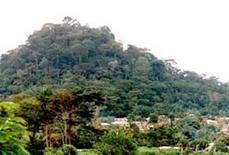
Richly endowed with minerals, Guinea possesses an estimated one-third of the world's proven reserves of bauxite, more than 1.8 billion metric tons (MT) of high-grade iron ore, significant diamond and gold deposits, and undetermined quantities of uranium. Guinea has considerable potential for growth in the agricultural and fishing sectors. Soil, water, and climatic conditions provide opportunities for large-scale irrigated farming and agro-industry. Possibilities for investment and commercial activities exist in all these areas, but Guinea’s poorly developed infrastructure and rampant corruption continue to present obstacles to large-scale investment projects.

Richement dotée de minerais, la Guinée possède un un tiers environ des réserves mondiales de bauxite, plus de 1.8 milliard de tonnes métriques (TM) de minerai de fer de haute qualite, des dépôts significatifs de diamant et d'or, et des quantités indéterminées d'uranium. La Guinée a un potentiel considérable pour la croissance des secteurs agricoles et de pêche. Le sol, l'eau, et les conditions climatiques présentent des opportunites d'affermage et d'agro-industrie irriguée à grande échelle. Les possibilités pour l'investissement et les activités commerciales existent dans tous ces secteurs, mais l'infrastructure mal développée et la corruption effrénée de la Guinée continuent à présenter des obstacles aux projets d'investissement à grande échelle.

On a day-to-day level the economic situation of most Guineans is very poor. Inflation is high and prices of key goods, particularly rice and fuel, have risen dramatically in 2004. Such price increases led to riots in major towns and a growing feeling of unease and dissatisfaction.

Concretement, la situation économique de la plupart des Guinéens est très pauvre. L'inflation est haute et les prix des marchandises principales, en particulier du riz et du carburant, ont monté nettement en 2004. De telles augmentations des prix ont mené aux émeutes dans les villes principales et à un sentiment croissant de malaise et de mécontentement."

(Source : HOC Visitors Guide)

The Beaver


My guest map is wonderful ! And you'd all be wonderful to post, all of you lurk mode readers!
Thanks and may the winds of Fate blow your way !