Showing posts with label social conscience. Show all posts

June 22, 2009


If you are reading this right now, you have more luxury than someone in Iran could ever hope for right now. If you are watching TV or a video on youtube, updating your status on Facebook, Tweeting, or even texting your friend, you are lucky. If you are safe in your home, and were able to sleep last night without the sounds of screaming from the rooftops, you need to know and understand what is happening to people just like you in Iran right now.


They are not the enemy. They are a people whose election has been stolen. For the first time in a long time, a voice for change struck the youth of Iran, just as it did for many people in the United States only seven months ago. Hossein Mousavi gained the support of millions of people in Iran as a Presidential candidate. He stands for progressiveness. He supports good relations with the West, and the rest of the world. He is supported with fervor as he challenges the oppressive regime of Mahmoud Ahmadinejad.

On Friday, millions of people waited for hours in line to vote in Iran's Presidential election. Later that night, as votes came in, Mousavi was alerted that he was winning by a two-thirds margin. Then there was a change. Suddenly, it was Ahmadinejad who had 68% of the vote - in areas which have been firmly against his political party, he overwhelmingly won. Within three hours, millions of votes were supposedly counted - the victor was Ahmadinejad. Immediately fraud was suspected - there was no way he could have won by this great a margin with such oppposition. Since then, reports have been coming in of burned ballots, or in some cases numbers being given without any being counted at all. None of this is confirmed, but what happened next seems to do the trick.


The people of Iran took the streets and rooftops. They shout "Death to the dictator" and "Allah o akbar." They join together to protest. Peacefully. The police attack some, but they stay strong. Riots happen, and the shouting continues all night. Text messaging was disabled, as was satellite, and websites which can spread information such as Twitter, Facebook, Youtube, and the BBC are blocked in the country. At five in the morning, Arabic speaking soldiers (the people of Iran speak Farsi) stormed a university in the capital city of Tehran. While sleeping in their dormitories, five students were killed. Others were wounded. These soldiers are thought to have been brought in by Ahmadinejad from Lebanon. Today, 192 of the university's faculty have resigned in protest.

Mousavi requested that the government allow a peaceful rally to occur this morning - the request was denied. Many thought that it would not happen. Nevertheless, first a few thousand people showed up in the streets of Tehran. At this point, it is estimated that 1 to 2 million people were there. Mousavi spoke on the top of a car. The police stood by. For a few hours, everything was peaceful. Right now, the same cannot be said. Reports of injuries, shootings, and killings are flooding the internet. Twitter has been an invaluable source - those in Iran who still know how to access it are updating regularly with picture evidence. People are being brutally beaten. Tonight will be another night without rest for so many in Iran no older than I am. Tonight there is a Green Revolution.


For more information:
PICTURES:
here and here
NEW INFORMATION:
Here - near constant updates
Here - ONTD_political live post
ON TWITTER:
@StopAhmadi, @ProtesterHelp


دنیارابگوییدچطورآنهاانتخاباتمان دزدیده اند
Tell the world how they have stolen our election


- original post by [info]one_hoopy_frood
</div></div>

My heart goes out to these people. I want to be there. I want to fight for something this right. This, this, this. Is why it pisses me the fuck off when people don't appreciate what we have.

THINGS YOU CAN DO TO HELP

# The most obvious thing to do is stay informed. Keep an eye on reliable sources on Twitter, refresh blogs and news sites that are covering the stories.

# If you are on twitter, retweet information from reliable twitters, but REMOVE THE USERNAME if they are in Iran. People have died because of the lack of responsibility by fellow tweeters and the media in this front. They can be tracked down by the government of Iran.

# Spread the information elsewhere. Repost this article or write your own on Facebook, Myspace, Tumblr, or anywhere else you can think of. If you write your own, make sure you are concise and accurate. Link to your sources for people to learn more.

# Change your location on Twitter to Tehran or Iran, and your time zone to GMT +3:30.

# DO NOT auto-refresh and take down websites, even if you are asked. It slows down the internet for the rest of the people in Iran.

# If you make a proxy DO NOT post it publically, otherwise it is useless. Send it in a direct message to a trusted source.

# DO NOT spam the hash tag #IranElection with useless things to "confuse the government". This does not help at all.

March 12, 2009

What I've been doing lately

Paper writing. It seems to almost be all that I do these days.

Since the beginning of the term, this is what I have produced:
  • History in Tony Kushner's Angels in America: Millenium Approaches, or the quest for a sexual or a historical identity ;
  • A reflection on the development of the Northumbrian dialect between the 8th and the 12th century ;
  • Bartleby the Scrivener: an evocation of the Statue of Liberty ;
  • A detailed analysis of Ronsard's 9th Sonnet to Hélène, or the protrayal of a love duel ;
  • Béroul's Tristan & Isolde, the symbolism of the Mal Pas, or the farce which allows to reintegrate the social space.

I also have the following assignments to produce over the coming weeks:

  • A lexicographic analysis of three semantically related words ;
  • Madness and marriage in Virginia Woolf's Mrs. Dalloway and Charlotte Gilman's The Yellow Wallpaper ;
  • A study of the mutual influences of the French and English languages one on another.

There is one more larger essay for which I need to pick my topic, but it isn't due for a bit, so I do have time to decide.

Ah, woe is me. I do enjoy what I'm doing, though. I'll post excerpts when I can get to editing the raw bits.

Even if so far, I'm doing extremely well with my work.

The Beaver
My guest map is wonderful ! And you'd all be wonderful to post, all of you lurk mode readers!
Thanks and may the winds of Fate blow your way !

February 18, 2007

Beaver visits the simple path (Threading in the footsteps of an icon is also part of the game)

Upcoming posts:
- the super-power of complaining
- Gandhi's Ashram - the pearl of Ahmedabad

The last night before I left Kolkata, I had the immense honor of being introduced to the Missionaries of Charity's motherhouse and to their working grounds.

Of the ignoramus reading this, the Missionaries of Charity are the order of nun, brothers, and lays that was founded by Mother Theresa. If you come from Mars and don't know who Blessed Mother Theresa is (or if you are from Earth and curious to know more about her life), click here.

Again, I was out of battery when I went, so I had to rely on Google to "borrow" some illustrations.

We started off by going to the house of Mother Teresa, and pay our respects to her tomb.

When one enters the home of the missionaries of Charity, there is a strong sense of peace and devotion. Anyone can only be humbled by the generosity and the dedication of the M.O.C. Just to see how dedicated one must be to be a M.O.C... here is the path they must take.
  • Aspirancy--6 months.

  • Postulancy--Up to 1 year.

  • Novitiate--2 years. First vows are taken after this.

  • Juniorate--5 years. Vows are renewed each year.

  • Tertianship--The 6th year of vows, after which final vows are taken.

Once the full vows are taken, the newly hatched M.O.C. can visit her family for 2 weeks, every NINE YEARS !!! That's some dedication for you !

Once we were done, we were allowed to see Mother Teresa's room, although pictures were not to be taken. It was a simple, humble and very small room with a sober bed, table and chair. A crucifix adorned the room. Nothing schocking from the woman who adopted the simple path.

THE SIMPLE PATH

The fruit of silence is PRAYER.

The fruit of prayer is FAITH.

The fruit of faith is LOVE.

The fruit of love is SERVICE.

The fruit of service is PEACE.

Once that was done, we visited the largest orphanage in Kolkata, where we met the children that are fostered by the M.O.C. It was just rooms and rooms full of children, babies, toddlers, boys and girls, healthy, ill, handicapped, happy, sad, indifferent, but all lively and beautiful because so full of life.

In one of the rooms, a little boy, maybe 18 months old, took a liking to me. He would just talk to me, and thrown his arms open at me. Most of the children I met were eager to be held, curious of my difference, and expressing a very important need: love.

I fell in love and got my heart broken countless times that night. I wanted to leave everything and adopt as many of these little ones as I could. I wanted to give them a home. But quitting would have made giving them a home difficult, aside from the fact that I am a gipsy at that moment. I don't even have a trailer !!!

The Beaver

My guest map is wonderful ! And you'd all be wonderful to post, all of you lurk mode readers!
Thanks and may the winds of Fate blow your way !

February 03, 2007

In my last life, I was....

THERE IS A MOVIE HIDDEN IN THIS VERY VERY LONG UPDATE.
THERE ARE ALSO PICTURES AND A FUN TEST TO TAKE !

Otherwise, be patient and hear about my field trips to North and West Bengal from these last two weeks...

For West Bengal pics click here.
For North Bengal pics, click here.


The whole thing was an ordeal to be honest. It started on Sunday - my colleague (let's call her June) and my 2 local counterparts (let's call them Bob and Patel) drove to the Kolkatta airport to catch our flight to the Bagdrogra air base.

Of course, nothing ever is THAT simple. So it started off with us having to wait an extra hour, with me undergoing a particularly thorough security check (oh boy do I hate those). We finally got on the plane, which took off. Everything seemed to be going well (at least this time I had made the flight) - but my proverbial bad karma caught up with us.

The poor landing conditions in Bagdogra - apparently there was too much fog - scared the pilot. He turned the plane around after having hovered over the base for 2 hours (it's typically a one-hour flight) and took us back to KOL. By the time we deplaned, found a car, underwent the long drive back with the mandatory 5 long stops in traffic, I got back to the hotel, disgruntled and disgusted that I had lost a sunday afternoon in KOL for no good reason.

Anyway, the next day we tried again and succeeded. I count myself lucky because some people had been trying to get to Bagdogra since Saturday!

Upon arrival, we greeted the staff of the office and even had a long sit-down with the local Bishop. That man made a memorable impression on me. Such a lovely person, well spoken, invested in his diocese, and so very aware of the local issues. I will remember our conversations very fondly. Some topics that were touched on:
- Elephants are a nuisance in North Bengal. One even disturbed an outside service, sending the priest to run for his life !
- The main livelyhood in the area is the famous tea gardens which produce the well known Darjeeling tea. Most of these tea gardens are owned by private owners and the conditions of the workers (most of which are form the Ranshi area) are not in conformity with international labor standards. Additionnaly, their income is directly tied to the productivity of the garden - so they are the first to suffer from the weather's inconsistencies.

Tea Garden

Basically, I was going there to meet with our local counterparts and evaluate their systems. As part of my work, a whole day was spent out in the field visiting the small local organizations who actually channel the ressources (in this case, the food) to the people it is destined to (in this case, children from the tea garden families.) The first place I went to was Julilee Memorial School - the children were, of course, absolutely beautiful. They also were very shy since they had never met a foreigner before. After a shortwhile, they loosened up though, as you can see here :

Saint Francis' School 2

The children also presented their Indendence Day program which I filmed... so here it is !


The second school I went to was actually an orphanage. I visited the facilities and met the children. They were also very shy, but the group picture I took seemed to really have made their day :


Don Bosco School 12

It was very touching - but also saddening because the public agency that is currently feeding these kids is ending the program in four years. And when you see the children and their caregivers, you do understand that the need is not going to go away in only 4 years.

Thankfully, there was, again, a beautiful sunset to soothe my soul on the way back:

Crematorium at Sunset

At the hotel, an alternate reality was waiting for me. The Sao Paolo soccer team was staying on my floor ! It was like living in a Brazilian dorm !
Soccer Giants

I got back to Kolkata just on time to go out with June for dinner - but not before i got the famous Mohindi tatoo done !

India 044

That feeling was intensified this week after I visited two other schools in the Baruipur region (in West Bengal). They were much poorer than those I visited in the North. Both schools were in fact nurseries, and again I had a chance to meet the beautiful children who attend at the first one:
Children at lunch - Kearakali Jana Sevashram

Because it took us too long to reach the second school, the survey team actually got there after the children went home, but the teachers were waiting for us and gave me a presentation of their teaching techniques. All the teachers are mothers who have children in school and reconverted to teaching.
Teacher Demo - Nimpith Tulshighata Netaji Sangha

Although the schools were very poor, it was so touching to see how the teachers had really invested in creating activities and materials to really engage the children in their learning process. It was also very appeasing to to see the Bengali countryside and village scenes.

Now I'm back in Kolkata and slowly coming back to my normal state. The daily drives to Baruipur have, I must admit, really taken their toll on me....

==========================================

Now for the big reveal :

In my last life, I was...........

A Friendly Alien

You scored 36 alien-ness, 28 mythical-ness, 52 angelic-ness, and 16 regal-ness!

Have you ever seen the Steven Speilburg film E.T? You also are a gentle being from another planet, where you have spent most of your previous incarnations. The strife and violence on earth hurts you. Your only wish is goodwill and kindness to mankind. You have a talent for healing - both plants and animals - and should consider some study in this area.

At best you were gentle, gracious and radient.

At worst you were indescive, aloof and clumsy.

In this lifetime you have gifts of diplomacy you should put into use! You'd be wonderful at running a country but are too gentle to promote yourself in election. Be assertive. You're a lovely human being.


This test tracked 4 variables. How the score compared to the other people's:
Link: The PREVIOUS INCARNATION Test written by Fyrdancer on Ok Cupid

The Beaver


My guest map is wonderful ! And you'd all be wonderful to post, all of you lurk mode readers!
Thanks and may the winds of Fate blow your way !

December 21, 2006

Introspective Post and Season's wishes

It’s a Tuesday afternoon, and I am not working. I just made eggs and toast for myself, jazz is playing in the kitchen, and the sun room where I am sitting is filled with the Toronto grey skies. It’s the first time I have in about a month to really sit down and reflect. It’s a scary thing. Last time it happened, I wrote a post called Cul-de-sac – and it was so very depressing and somewhat tragic.

This time – I am at peace. So much has happened between Cul de Sac and now. Last time I took the time to write an introspective post, I was in Haiti, sequestered, lonely, bored and depressed. This time, I am in Toronto, in one of my homes away from home, Pgwrox’s lovely townhouse where I have now been enough times to know my way around and feel at home. I am rested, sated, and somewhat content.

Meulaboh Sunset


Christmas is coming round and I feel no fear, for the first time in a long time. Dad won’t be there, of course. CQFD will not be there either. My mum, PG and I will be celebrating the family thing together, as the tightly knit family that we are, despite distances.

My mum and I will be the 2 widows that we are, her in her own right, me…. in my own way. Last year, at this time, we were decorating the Christmas tree, CQFD and I, at his parents’ house. I was at peace, happy, in love. I felt like it was a day of days. I felt like that moment was immortal.


Louvre, Le Baiser


But all moments are immortal. And so while my 4 years with CQFD are suspended in time, so are my memories of my Yankee lover immortal, his warmth, and how I felt happy and at home in his arms, though I may never see him again.


Louvre, La victoire de Samotrace


And so timeless are the memories of my friend Naya, grilling red peppers while chatting with her sister at the other end of the world, and so are those of the Peacekeepers of Haiti, whom I may never see again but carry forever in my heart.

The Belgian crew in Bujumbura and the Philippinos in Aceh, and of course the orphans in Sierra Leone, the staff in Liberia and CMR & Princess, whom I met in Pakistan, now scattered in Zambia and Australia, my family in France and Canada, all of you will stay in my heart for ever.


Fon Sail 4 (Ganvie)


All of my fellow officers are immortal. They are all unique and special and beautiful in their own way. And I love them all, in a way that is unique to them. I will miss them during this month of rest, and I will miss some of them more until I work with them again, sometimes 6 or 7 months from now.

This year has been a busy and eventful year. I have been ill. I have had my heart broken. I have also learned much and grown in wisdom and confidence through it all. Friends have died, and babies were conceived. Love was lost and friendships were found, built and nourished. Decisions were made, lessons were learned and through it all, the wheel of life kept turning, inexorably and timelessly.


So on the eve of Christmas 2006, may your time with your loved ones be rich, filled with love and may it remain suspended in time, shimmering and bright for you to remember, should hardship befall you. We are all immortal, timeless, evanescent. And all of you readers, may you find in this holiday season the power to love, forgive and to remember.

The Beaver

November 13, 2006

Speak out !

I uploaded some new beautiful pics of the Carribean Sea - just click on the side bar Flickr badge to see them. There are some fun stories to tell about snorkling and sailing, but for now I want to talk some more about the fight against intolerance and what we can do to help. It's not only about seeing a movie. It's mostly about doing what is right, and building a better place.

This all started with The Laramie Project. I posted some more about it just HERE.

The man who got brutally killed and tortured in Laramie because he was different was Matthew Sheppard. It happens I didn't know him - but that doesn't matter because next time it could be my friend or my relative. It could also be yours. The mobile of his vile murder was HATE. It was in 1998, and it's still happening.

I just checked the state in which I spend the most time (Maryland), and was appalled to find out that there are 7 hate groups in the state, 4 of them being based on Baltimore. To me, that's a major eye-opener.

*Although the Southern Poverty Law Center recognizes that much black racism in America is, at least in part, a response to centuries of white racism, it believes racism must be exposed in all its forms. White groups espousing beliefs similar to Black Separatists would be considered clearly racist. The same criterion should be applied to all groups regardless of their color.

If you want to check out what is going on in your state, click HERE.

I have gay friends and relatives. I have friends from all ethnicities. Because I love them, this concerns me. I have been around the world enough to know that this issue concerns us all. So I took the PLEDGE TO SPEAK OUT, and I encourage you all to take it as well, no matter who you are, where you come from, what your background is. We are all in this together.

I am reproducing it for your information, and thus am reiterating my wow to speak out against intolerance and bias.

I, the Travelling Beaver, will:

  • Speak up when I hear or see bigotry;
  • Question and identify bias when I see it;
  • Be mindful of my own behaviors;
  • Promote and appeal to higher principles;
  • Set limits on what is said or done around me;
  • Seek help and help others to work against bigotry; and
  • Remain vigilant and persistent.
Intolerance must be fought, because it affects all of us.

For more information visit Tolerance.Org

If you know of other organizations that partake in such campaigns, let me know and i will also list them here for referrence.

The Beaver

Speak out !

November 12, 2006

Parentheses

I have plenty to tell about last night and today.... for I want to set my frivolities aside tonight and talk to you, gentle reader, about something important to me.

I just finished seeing this movie and felt I should immediately share it. This is moving, disturbing, and necessary. We all have a conscience. The Laramie Project reminds us that tolerance is an ongoing fight and explores the deep confines of what I can only refer to as collective guilt.


"The brutal attack on Matthew Shepard was the kind of wakeup call a society doesn't get very often. It triggered an avalanche of media, a kind of national deathwatch until Shepard died five days later. THE LARAMIE PROJECT is the response of one man, playwright Moisés Kaufman, and his colleagues at the Tectonic Theater Project, who went to Laramie, Wyoming, and conducted more than 200 interviews with townspeople and officials. The result is this inquiry into hate and the thoughts and feelings of an American community. As one local states, Laramie became instantly notorious, "like Waco or Jasper." But The Laramie Project is not an exercise in self-righteous condemnation. It merely attempts to come to terms with what happened. It's a film, based on the play by the troupe, that presents the details of the slaying as revealed by those closest to it, and the truth lies in the details. It's a film about homophobia across the nation, but as one woman deftly points out, "Honey, it's still about Laramie."

It was Matthew Sheppard, but it could have been my friend or my relative. It could also be yours.

For more information visit Tolerance.Org

The Beaver

My guest map is wonderful ! And you'd all be wonderful to post, all of you lurk mode readers!
Thanks and may the winds of Fate blow your way !

July 23, 2006

Horror and Shame

Below is my personal take in a discussion that has been going on here.

Steven Harper, our conservative prime minister, newly elected in December 05, has been brown nosing with Dubya ever since. With now confirmed rumors that the US are participating in the Israeli attack plan, more and more canadians feel that Harper has broken the image of neutrality and tolerance that Canada usually has across the world.

Moreoever, his evacuation plan moves at snail pace, and he has NOT taken action since some Lebenase-born Canadian citizens have been killed in the attacks.

There are rumors that we will go in election mode again in the fall to get rid of this useless politician, and Canadians are down in the street to express their discontent.

My word is this: if your government is supporting the Israeli attack, go in the street and support the protest efforts.

If you are an American citizen, consider your options. The Democrats are not disapproving the Republican support to Israel, which I guess means a third road is starting to be PARAMOUNT.

As far as I'm concerned, if Canada remains conservative, it's likely that I will join the soveignist cause in Quebec or move to France. I have no interest in being affiliated with Harper's support to the massacre of innocents.


The Beaver

My guest map is wonderful ! And you'd all be wonderful to post, all of you lurk mode readers!
Thanks and may the winds of Fate blow your way !

July 13, 2006

Today is a black day

Mourning, by Wayne Forte

I don't have too much time to post, but I found that Wikipedia's entry about the Israeli-Lebanon crisis is pretty exhaustive.

Here's the link. Great if, like me, you've been slightly disconnected from international current events. This is a controversial subject, so do visit the discussion tab on the page as well.

Wikipedia's crisis article

I'm still trying to wrap my head around this, so I will reserve my opinion for now.

The Beaver

March 20, 2006

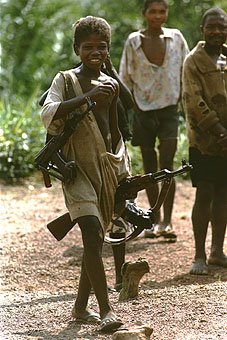
Lettre a un jeune soldat / Letter to a young soldier

Child soldier, Liberia (1997) -
WCC (Francais)
WCC (English)
«Les enfants sont notre avenir. Accepter que des enfants soldats participent à des conflits armés, c’est accepter la destruction de notre avenir, un enfant après l’autre.»

Kofi Annan, Session extraordinaire de l’ONU consacrée aux enfants, mai 2002


Ton corps est un temple, garde le. Ne laisse pas l'ombre du mal t'approcher.
Un fusil est une arme. C'est un objet mature pour une main mature. Si ton index ne trouve pas la gachette, laisse le.

Your body is a temple, keep it. Do not let the shadow of evil near you.
A gun is a weapon. It is a mature object meant for a mature hand. If you index cannot find the trigger, leave it.

Pense a ta mere si tu vois une femme.
Pense a ton pere si tu vois un homme.
Si tu vois des enfants, pense a tes freres et soeurs.

If you see a woman, think of your mother.
If you see a man, think of your father.
Think of your brothers and sisters when you see children.

Ton ame est un tresor. Toi seul en est le gardien. Toi seul peut la garder.
Ton esprit est un lieu de songes et de beaute. Interdit-toi la violence.

You soul is a treasure. You only are its warden. Only you can keep it.
Your spirit is a place of dreams and beauty. Forbid yourself from violence.

Tes yeux sont des mysteres insondables. Ils portent en eux tout ce que tu es. Ils sont tout ce que tu as de beau et d'unique.

Your eyes are neverending mysteries. They carry all that you are. They are all that you have that is unique and beautiful.y

Ta vie est un chemin ouvert. Prend la a bras le corps, ne la laisse pas s'echapper.

Your life is an open road. Take it by both hands, do not let it slip away.

Ton sourire est ton innocence. Partage le.

Your smile is your innocence. Share it.

Tout ce que tu apprends, garde le en memoire. Un jour, tu le transmettras.

Remember all that you learn. One day, you will share it too.

The Beaver

November 07, 2005

About South Africa / A propos de l'Afrique du Sud

About South Africa / A propos de l’Afrique du Sud

I dedicate this post to all the South-Africans of all origins who died, suffered imprisonment, or just took the risk to get out there, to make the Rainbow State a better place. I dedicate this post to all those who suffered unjustly because of their gender, color, religion, sexual orientation or political opinions.

Je dedie ce texte a tous les Sud-Africains de toutes origines qui sont morts, ont ete emprisonnes, ou qui ont simplement pris le risque de s’exposer pour que l’Etat Arc-En-Ciel soit un meilleur pays.  Je dedie ce texte a tous ceux qui ont injustement souffert, en raison de leur sexe, couleur, relition, orientation sexuelle, ou opinions politiques.

South Africa is famous for its ominous apartheid era.  Though this segregation system was abolished 10 years ago, it still hovers in the mind of all who thread its soil.  Indeed, the wounds are not yet healed.  I will further in another post the aftermath of Apartheid as I observe it in Jo’Burg, but for now, let’s go down the road of past history, to better understand the present.

L’Afrique du Sud est celebre pour l’infame periode de l’Apartheid. Bien que ce systeme de segregation ait ete aboli il y a 10 ans, il plane toujours dans l’esprit de ceux qui foulent son sol.  En effet, ses blessures ne sont toujours pas gueries.  Dans un texte subsequent, je ferai le decompte de l’abolition de l’Apartheid tel que je l’observe a Jo’Burg.  Mais pour le moment, explorons le passé, afin de mieux comprendre le present.


The first inhabitants
The first known inhabitants of South Africa were the Bochiman, also known as San, and the Hottentots, also know as Khoikhoi.    The Bantu then emigrated in the region.  The iron-age technologies developed by these early inhabitants were not surpassed in Europe until the Industrial revolution of the 19th century.

Les premiers habitants
Les premiers habitants connus en Afrique du Sud etaient les Bochiman, aussi connus sous le nom de San, et les Hottentots, aussi appeles Khoikhoi.    Les Bantu migrerent plus tard dans la region.  Les technologies de l’age de fer de ces premiers habitants n’ont pas ete surpassees en Europe avant la Revolution Industrielle du 19eme siecle.


Who are the Afrikaners?
As a by-product of the European race to Asia, the Dutch East India Company implemented the first European settlement in South Africa in 1652.  This was on the Cape of Good Hope, known today as Cape Town.  Cape Town is at the tip of Africa, on the western fringe.  The original colony grew and this early settlement became the destination of Dutch Calvinists and other European Protestants who were fleeing religious repression.  Overtime, they developed their own language, Afrikaans, a mutated version of Dutch.
The settlers, known today as the Afrikaners or Boers, became a close-knit community and imported slaves from other African regions and South-East Asia. This was one of the root origins of the people denominated under the Apartheid as “colored”.

Qui sont les Afrikaners?
Un effet secondaire de la course Europeenne vers l’Asie, la Compagnie Hollandaise des Indes Orientales fonda la  premiere colonie europeenne en Afrique du Sud en 1652.  C’etait au Cap de Bonne Esperance, connu aujourd’hui sous le nom de Cape Town.  Cape Town est au bout de l’Afrique, sur l’extremite occidentale.  La colonie du debut a grandi et ce premier comptoir devint la destination des Calvinists Hollandais et d’autres Protestants Europeens fuyant la repression religieuse.  Avec le temps, ils developpernet leur proper langue, l’Afrikaans, une version mutee du Hollandais.
Les colons, connus aujourd’hui sous le nom d’Afrikaners ou de Boers, devinrent une communite tricotee serre et importerent des esclaves d’autres regions d’Afrique et d’Extreme Orient.  Il s’agit d’une des origins des gens appeles sous le regime de l’Apartheid “gens de couleur”.

The first clashes
Between 1652 and 1779, the Afrikaners expanded East of Cape Town and clashed violently with the Bantu tribes.  The Xhosa put their expansion to a halt in the first tribal war in 1779.  

Premiers conflits
Entre 1652 et 1779, les Afrikaners s’etendirent a l’Est de Cape Town et affronterent violemment les tribues Bantu.  Les Xhosa arreterent leur expansion pendant la premiere guerre tribale en 1779.  

English occupation
In 1806, the English annexed Cape Town.  This led to further exile and Boer expansion away from Cape Town.  In 1834, England abolished slavery.  In Cape town, over 35000 black slaves were emancipated.  This led to much discontent in the Afrikaner community, who perceived this to be an unacceptable interference in their affairs.   As  a result, what is known as the Grand Trek in history happened : countless Boer families migrated across the Orange River deep in the country to what is now Bloemfontein in the Free State (an actual province of South Africa).

L’occupation Britannique
En 1806, les Anglais annexerent Cape Town.  Le resultat direct fut l’exil loin de Cape Town et l’expansion des Boers en territories inexplores.  En 1834, l’Angleterre abolit l’esclavage.  Au Cap, plus de 35000 esclaves noirs sont emancipates.  Cela mecontenta, la communaute Afrikaner, laquelle perçut cette mesure comme une ingerence inacceptable dans leur affaires.  Ce fut la cause directe de ce qui est connu dans l’histoire comme le Grand Trek: d’innombrables familles Boer migrerent au dela de la Riviere Orange, au coeur  du pays, et fonderent Bloemfontein dans le FreiStadt (aujourd’hui une province d’Afrique du Sud).

War, war, and more war
Although the English had abolished slavery, this did not make them allies to the Zulu and Xhosa tribes.  Their pressure, combined with the Boer migration, allowed the Zulu king Shaka to come to power.  He waged war mercilessly on the neighboring tribes and caused immense suffering and a mass migration of the Bantu tribes in what was known in history as difaqane (the Scattering).  Eventually, the Zulu were defeated by combined British and Boer forces.  However, their relationship remained tense as the Boers harbored a secessionist agenda, which concretized in the Boer Republics of Free State and Transvaal.

La guerre, la guerre, et encore la guerre
Bien que les Brittaniques aient aboli l’esclavage, ils n’etaient pas allies des tribues Zulu and Xhosa.  Leurs pression, en conjonction avec la migration des Boer, permis au roi Zulu, Shaka, d’atteindre le pouvoir.  Il fit la guerre sans pitie aux tribus voisines, causant ainsi de grandes souffrances et de massifs mouvements de populations Bantu, connus aujourd’hui dans l’histoire comme le difaqane (l’Eparpillement).  Eventuellement, les Zulu furent vaincus par la combinaison des forces britanniques et Boer. Cependant, leur relation resta tendu, car les Boers avaient un agenda secessioniste, lequel se contretisa dans les Republiques Boer de Frei Stadt et du Transvaal.

Diamonds and Gold
In 1867, diamonds were discovered in Kimberley and gold was discovered in 1886 on the Witwatersrand ridge in Johannesburg.  This attracted both English miners who were heavily taxed but unable to vote in the Boer Republics and British imperialists to the Boer Republics, much to the irritation of the Boer farmers.
Amongst them, a British businessman, Cecil Rhodes, found interest in the Boer Republics.  His interest was for British rule to overrun the Boer Republics, thus he fomented uprisings amongst the English miners.  

Or et Diamants
En 1867, des diamants furent decouverts a Kimberley, et de l’or fut decouvert en 1886 sur la chaine du Witwatersrand a Johannesburg.  Au mecontentement des fermiers Boers, ceci attira dans les Republiques Boers a la fois des mineurs anglais, surtaxes mais interdits de vote, et des imperialists britanniques.
Parmis eux, un homme d’affaire britannique, Cecil Rhodes, pris interet dans les Republiques Boer.  Ayant interet a etablir la suprematie britannique en Republique boer, il fomenta la revolte des mineurs anglais.  

The War of the Boers
The miner rebellions augmented the already existing tensions between Britain and the Afrikaners and in 1899, the war known as War of the Boers erupted.  This was a cruel war, as Britain pursued a Scorched Earth policy to combat Afrikaner guerrilla, destroying homes, crops and livestock.
Between 1899 and the end of the war, 26 000 Afrikaner women and children died in what became known as the first concentration camps in history.  In 1902, British rule over South Africa was confirmed and the Boer Republics were annihilated.

La guerre des Boers
Les rebellions minieres aggraverent les tensions deja existante entre la Grande-Bretagne et les Afrikaners et 1899 vit l’eruption de la Guerre des Boers.  Ce fut une guerre cruelle, car la Grande Bretagne appliqua la tactique de la terre brulee afin de contrer la guerrilla Afrikaner, detruisant foyers, cultures et betail.
Entre 1899 et la fin de la guerre, 26 000 femmes et enfants Afrikaner moururent dans ce qui est maintenant reconnu comme les premiers camps de concentration de l’histoire.  En 1902, le controle britannique sur l’Afrique du Sud etait confirme et les Republiques Boer detruites.

The institution of Apartheid: a timeline
These are only a few dates to situate the history.  I do not have the pretension of being exhaustive.
  • 1910: the Union of South Africa was created, with the whites in total control of the in political scene.  Moderate protestations on part of the black majority, in the form of strikes and political gatherings were mercilessly repressed.

  • 1948: the Afrikaner National Party won the elections and went further in preventing all non-whites from having any political or economical power.  Brutal enforcement of this is common practice.

  • ? : Creation of the African National Congress, first organization against apartheid.  In response to the government’s unwillingness to undertake reforms, the ANC undertakes guerilla.

  • 1960: one of the bloodiest episodes of the repression happens in the Sharpeville massacre.

  • 1960’s: arrestation and imprisonment of ANC political activists, including Nelson Mandela.

  • 1970’s: creation of the Bantustans, theoretically independent countries and so-called Black homelands (Transkei, Cickei, Bophutswana and Venda.)  All blacks within “white” designated areas are considered guest workers and thus lose all political rights.  Not having a residence pass means being deported to a “home” land.

  • 1976: dozens of Soweto school children protesting against the imposition of Afrikaans in school are shot by the police.  Following this event, Soweto was the stage of bloody and senseless murders of black children by the Police.  This marks the beginning of international awareness of the fate of the black South-Africans.
Without dates, I will add that political activists were such as the well-known Steve Biko imprisoned, tortured, and killed.  Settlements were evacuated and bulldozed, such as the “colored” suburb of District 6, in Cape Town.  

L’institution de l’Apartheid: quelques dates
Il ne s’agit ici que de quelques dates dont le but est de situer l’histoire.  Je n’ai nullement l’intention d’etre exhaustive.
  • 1910: L’ Union de l’Afrique du Sud est creee, avec les blancs en controle total de la scene politique.  Des protestations moderees de la majorite noire, prenant forme de greves et de regroupements politiques, sont reprimes sans pitie.

  • 1948: le Parti National Afrikaner gagne les elections et va plus loin dans l’exclusion des non-blancs du pouvoir politique et economique.  La brutalite policiere est de coutume.

  • ? : Creation de l’African National Congress, premiere organisation anti-apartheid.  Devant la mauvaise volonte du gouvernement, l’ANC se tourne vers la guerilla.

  • 1960: un des episodes les plus sanglants de la repression se produit lors du massacre de Sharpeville.

  • Annes 60: arrestation and emprisonnement d’activistes politiques de l’ANC, y compris Nelson Mandela.

  • 1970’s: creation des Bantustans, en theorie des etas independent et pretendument lieux d’origine des noirs (Transkei, Cickei, Bophutswana and Venda.)  Tout noir en territoire designe comme etant “blanc” est considere comme un travailleur etranger et perd ainsi tous droits politiques.  Ne pas avoir de laisser-passer residential signifie la deportation dans un Bantustan.

  • 1976: des douzaines d’ecoliers de Soweto protestant contre l’imposition de l’Afrikaans comme langue d’instruction sont abattus par la police. A la suite de cet evenement, Soweto devient le theatre de meurtres sanglants et insenses d’enfants noirs par la Police.  Ceci marque le debut de la conscience internationale du destin des noirs d’Afrique du Sud.
Sans dates, j’ajoute que des activistes politiques tells que le bien connu Steve Biko furent emprisonnes, tortures, et tues.  Des lieus d’habitations furent evacuees et rases, comme la banlieue “de couleur” connue sous le nom de District 6, a Cape Town.  

International politics during apartheid
While Angola, Mozambique and Zimbabwe were successfully fighting for liberation and implementing Marxist inspired governments, South Africa was becoming more and more of an isolated case.  
This led to aggressive behavior on the part of the South-African government and to the invasion of South Angola by the South-African army.  South Africa also refused to participate in earnest negotiations about the independence of Namibia and sponsored anti-revolutionary groups in Mozambique and Angola.

La politique internationale pendant l’apartheid
Alors que l’Angola, le Mozambique et le Zimbabwe menaient avec success les luttes de liberation et voyaient naitres des gouvernements d’inspiration Marxiste, l’Afrique du Sud devenait de plus en plus un cas isole.
En reaction, le gouvernement sud-africain adopta une politique d’aggression et envahit le sud de l’Angola.  Dans la foulee, l’Afrique du Sud refusa egalement de participer aux negotiations concernant l’independance de la Namibie et commandita des groupes anti-revolutionaires au Mozambique et en Angola.

At last, international awareness
After the riots in Soweto in 1976, awareness budded in the minds of the white Johannesburg university students.  The Chinese government sent official letters of support to the liberation fighters of Soweto.  In the West, citizens became more aware and civil society movements for racial equality erupted. Eventually, the UN imposed economic and political sanctions.  
In response to international pressure, the South-African government made concessions aimed at pleasing the international community and instituted a new parliament constituted of whites, colored (mixed race) and Indians, but still excluding the black South-African citizens. Needless to say, this was considered to be insufficient by the UN and the international community.

Enfin, une conscience internationale
Apres les emeutes de Soweto en 1976, une conscience emergea dans les esprits des etudiants universitaires blancs de Johannesburg.  Le gouvernement chinois envoya des lettres officielles de support aux combatants de la liberation de Soweto.  En Occident, les citoyens devinrent plus conscients et des mouvements de solidarite sociale pour l’egalite raciale virent le jour.  Eventuellement, l’ONU imposa des sanctions economiques et politiques.  
En reponse aux pressions internationale, le gouvernement sud-africain fit des concessions dont le but evident etait de plaire a la communaute internationale et constitua un nouveau parlement constitue de blancs, gens de couleur et d’indiens, maintenant par ailleurs l’exclusion des Sud-Africains noirs. A l’evidence, ce geste fut considere comme insuffisant par l’ONU et la communaute internationale.


Change
In 1989, Frederick W. DeKlerk was elected president of South-Africa.  In response to the pressures from the international community, the release of political prisoners began.  Amongst them was the famed Nelson Mandela, tribal king and leader of the ANC, who was imprisoned for nearly 30 years.  DeKlerk initially proposed to free political activists without repealing the act that rendered black political activity illegal.  Mandela refused to be freed without political rights, and eventually, obtained the signing of a peace agreement with ANC and other anti-apartheid groups and the annulment of the Bantustan’s institution.  Nelson Mandela was freed on February 11th, 1990.
In 1994, the country’s first democratic elections took place, with Nelson Mandela’s ANC winning 62.7% of the votes, and the “white” party gaining 20.4%, enough to enable representation.  This was as well the period of the national reconciliation commissions, which allowed South-African citizens of all ethnicities to express anger, remorse and forgiveness.  Not everyone agreed, but Mandela’s philosophy was to allow the white South-Africans to remain, and to foster harmonious rapports amongst all citizens.

Change
En 1989, Frederick W. DeKlerk fut elu president d’Afrique du Sud.  En reponse aux pressions internationales, la liberation des prisonniers politiques fut amorcee.  Parmi eux, le celebre Nelson Mandela, roi tribal and chef de l’ANC, qui fut emprisonne pendant presque 30 ans.  A l’origine, DeKlerk proposait de liberer les activistes politiques sans annuler la regle rendant l’activite politique noire illegale.  Mandela refusa d’etre libere sans droits politiques, et eventuellement obtaint la signature d’un traite de paix avec l’ANC et les autres groupes anti-apartheid et l’annulation des Bantustans.  Nelson Mandela fut libere le 11 fevrier 1990.
En 1994, les premieres elections democratiques du pays eurent lieu.  L’ANC, representee par Nelson Mandela, gagne avec 62.7% des votes, et le parti “blanc” obtint 20.4%, suffisamment pour etre represente en chambre. Ce fut egalement la periode des commissions nationales de reconciliation, qui permirent au citoyens sud-africains de toutes ethnicites d’exprimer colere, remord et pardon.  Ce ne fut pas unanyme, mais la philosophie de Mandela etait de permettre aux Sud-Africains blancs de rester, et de permettre l’etablissement de rapports harmonieux entre tous citoyens.

What now?
In 1999, the country voted again.  Although Mandela retired, the ANC won the elections once again.  Thabo Mbeki is now the current president.  Early on, his presidency was welcomed with a reasonable amount of skepticism, as the general public did not know him quite as well as his predecessor, Nelson Mandela.  
In the early days of his presidency, Mbeki was the target of a fair amount of criticism as he apparently denied the existence of the South-African HIV-AIDS crisis, a situation that a number of international organizations acknowledged to be a humanitarian emergency.
One of his bolder moves was a power-sharing deal with the New National Party (the reformed architects of Apartheid), to face the co-opting opposition parties.
From 2001 up to recently, Mbeki has given reasons to worry to foreign investors and white landowners.  Indeed, Zimbabwe’s president Mugabe has pursued an aggressive (if not violent) reclamation of white-owned farms.  Mbeki’s obliviousness to this policy has been interpreted as tacit support and creating fear for white-owned land, further leading to an alarming devaluation of the Rand, the local currency.  

What now?
En 1999, le pays vota de nouveau.  Bien que Mandela a pris sa retraite, l’ANC gagne une fois de plus les elections.  Thabo Mbeki est le president actuel.  Au depart, sa presidence fur accueillie par une part raisonnable de scepticisme, car il etait moins bien connu du grand public que son predecessor, Nelson Mandela.  
Au debut de son mandat, Mbeki fut la cible d’une part raisonnable de critique, alors qu’il nia l’existence de la crise sud-africaine du VIH-SIDA, une situation reconnue comme une urgence humanitaire par nombre d’organisations internationales.
Un de ses gestes les plus audacieux fut de faire une entente de partage de pouvoir avec le New National Party (les architectes de l’Apartheid rebaptises), afin de faire face a l’opposition.
De 2001 a recemment, Mbeki a donne un motif d’inquietude aux investisseurs etrangers et aux proprietaires terriens blancs.  En effet, le president du Zimbabwe, Mugabe, poursuit depuis 4 ans une politique aggressive (sinon violente) de reclamation des fermes appartenant aux blancs.  L’absence de reaction de Mbeki a cette politique est interprete comme un support tacite et cree de vives inquietudes concernant les terres appartenant aux sud-africains blancs, menant directement a une devaluation alarmante du Rand, la monnaie locale.

Source: Africa on a shoestring (Lonely Planet)

October 15, 2005

Medicare in Conakry ? Soins medicaux a Conakry ?

(Lecteurs francophones, une version francaise apparait plus bas.)

I've been receiving emails of friends complaining that my blog is not updated often enough...

I want to apologize for that. The past week has been pretty busy with work, and I've been having trouble setting time aside to write up some updates.

Work this week has been grueling, yet, not really worthy of a blog entry. Most people would not find interest in my review of personnel management, or on the preparations of an inventory check...

So instead, let me tell you about the few activities that have occupied my free time.

Last saturday night, I had set out to have dinner with an american woman I'd met at my hotel. So I hired out a driver for the night and drove over there. She was friendly, so I thought it would be nice for a change to be with a person who was not a co-worker (understand me, I love my coworkers, it's just that it's nice to meet new people.)

So I make it to the hotel and meet up with N. Right off the bat, she asks if i would mind running a small errand with her. She wants to go buy some medecine for this woman who works at her hotel. We try to figure out the best pharmacy to go to, and by the time we made a choice, the woman in question, H, decides that she wants to go to the hospital. N tells her she'll pay for everything, and to please pick where she wants to go. With my driver, we set out for the hospital.

Electricity in Conakry is scarce, and the Ratoma Public Hospital doesn't have a generator, so the whole place was in darkness when we got there. H was set up on a bed, without a pillow or a sheet. This was a small room, and the only lighting was a candle. Her 2 little boys, which we'd picked up on the way were crying in my arms and in N's.

Fifteen minutes later, a nurse came to check up on her. H was obviously in pain, and in a very bad state of health. She was not offered a painkiller or anything else.

N was anxious of H's welfare, so she insisted that we met with the doctors. They told us a battery of tests was to be done, and that the test would be done in the morning. To N's insistance, they agreed to do the tests right away. Conforted that we had done what we could, we left the hospital and took the children home, N promising to pop in on the next day.

We then went to have pizza at a libanese restaurant we'd been to before. N was still in schock at the level of the hospital. While I was more collected, having seen similar scenes in my teenage years in Burkina, I was still worried about our protegee. The owner of the restaurant recommended a clinic and we set out to the hospital again to see if a transfer was possible.

Arrived at the hospital, everything was pitch black. At the entrance, I noticed a group of people sitting down in the darkness. I called out the name of H's daughter, who had agreed to stand guard. Instead, H was there, on her feet, and greeting us with a smile !

Apparently, she was diagnose with diabetes. She was given an insulin injection, and felt just fine. She went home the same night.

Exactly one week after these events, I went back to see N. Our protegee has not reported to work for the last week. Maybe it wasn't diabetes after all...

The Beaver
P.S. Thanks, Andrea from England, for posting on my guestmap !


=====================================

J'ai reçu des email d' amis se plaignant que mon blog n'est pas mis à jour assez souvent...

Je vous presente mes excuses... . La semaine passée a été assez occupée avec le travail, et j'avais eu du mal a trouver le temps de préparer une mise à jour.

Le boulot cette semaine a été éreintant, pourtant, pas vraiment digne d'une entrée de blog. La plupart des gens ne trouveraient d'intérêt dans mon examen de gestion du personnel, ou sur les préparations d'un contrôle d'inventaire...

A la place, laissez-moi vous parler de mes temps libres. Samedi soir passé, je m'étais mis à dîner avec N, une américaine que j'ai rencontre à mon hôtel. Ainsi j'ai engagé un chauffer pour la nuit me suis rendue a son hotel. Elle était amicale, ainsi j'ai pensé que ca me changerait de mes collegues de travail (comprenez-moi, j'adore mes collègues, mais c'est bon aussi de rencontrer de nouvelles personnes.)

Donc, je me rends a cet hôtel et rencontre N. Immediatement, elle me demande si j'accepterais de faire une petite course avec elle. Elle veut aller acheter un certain medicament pour une femme qui travaille à son hôtel. Nous essayons de voir quelle serait la meilleure pharmacie ou aller, mais avant que nous ayons fait un choix, de la femme en question, H, décide qu'elle veut aller à l'hôpital. N lui indique qu'elle payera tout, et de choisir ou elle veut aller où elle veut aller. Avec mon conducteur, nous avons sommes partis pour l'hôpital.

L'électricité à Conakry est rare, et l'hôpital public de Ratoma n'a pas un générateur, ainsi tout l'endroit était dans l'obscurité quand nous y sommes arrivées. H a été installé sur un lit, sans oreiller ni drap. C'était une petite salle, et le seul éclairage était une bougie. Ses 2 petits garçons, que nous avions pris en chemin pleuraient dans des mes bras et dans ceus de N.

Quinze minutes plus tard, une infirmière est venue pour examiner H. Elle semblait souffrir, et dans un état de santé très mauvais, mais on ne lui a pas offert de quoi apaiser la douleur. N était inquiete du bien-être de H, ainsi elle a insisté pour que nous rencontrions les médecins. Ils nous ont dit qu'une batterie de tests devait être faite le lendemain matin. À l'insistance de N, ils ont accepté de faire les tests tout de suite.

Pensant que nous avions fait ce que nous pouvions, nous avons quitte l'hôpital et avons emmené les enfants chez eux, N promettant de passer le jour suivant. Nous sommes alors allés prendre une pizza à un restaurant libanais que je connaissais.

N était toujours sous le choc de l'hôpital. J'étais plus calme, après avoir vu des scènes semblables pendant mes années d'adolescence au Burkina, mais j'étais encore inquiété pour notre protegee. Le propriétaire du restaurant a recommandé une clinique et nous nous sommes rendues à l'hôpital pour à voir si un transfert était possible.

Arrivées à l'hôpital, tout était d'un noir epais. À l'entrée, j'ai noté un groupe de personnes assises dans l'obscurité. J'ai dit le nom de la fille de H, qui a avait accepte de tenir la garde. Au lieu de cela, H était là, sur ses pieds, nous saluant d'un sourire!

Apparemment, elle a ete diagnostiquee comme diabètique. On lui a fait une injection d'insuline, et elle etait comme neuve ! Elle est rentrée à la maison le même soir.

Exactement une semaine après ces événements, je suis allé de nouveau voir N. Notre protegee ne s'est pas fait presentee au travail de toute la semaine dernière. Peut-être ce n'était pas le diabète après tous...

The Beaver

P.S. Thanks, Andrea from England, for posting on my guestmap !

August 11, 2005

Taking the third road (independent sustainable development)

The Inspiration :

This post is inspired by a comment made on the Cuban government by The Voice.
"The wounds with Cuba are deep for America and the expatriates who were forced to leave Cuba after Fidel came to power. I have mixed feelings about it all because while Fidel's government is something I do not completely agree with, I understand his idealistic belief in distributing the wealth. It is evident he had tremendous hatred for American business interests which he felt were literally taking advantage of Cuba's beauty and treating her like a whore buying her, using her and ignoring her suffering.

Fidel's reaction to America was but an omen of how other third world people would react toward to the US in time. Viet Nam, Iran, El Salvador and many other nations began to stand up against the US business interests and the results have proven to be a steady decline in world opinion. America is fast becoming the only nation that believes itself to be a defender of freedom."

This side note reminded me of events long forgotten and inspired this long digression...

The Sankara Example

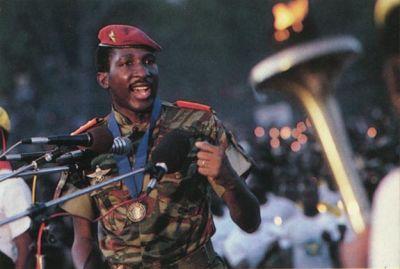
In 1987, I witnessed through the local media Fidel Castro's visit to Thomas Sankara, the president of Burkina Faso.

Mathaba worded perfectly the relevance of the Sankara example : "The revolution Sankara led between 1983 and 1987 was one of the most creative and radical that Africa has produced in the decades since independence. He started to blaze a trail that other African countries might follow, a genuine alternative to Western-style modernization and, like other radical African leaders such as Patrice Lumumba and Amilcar Cabral, was shot down as a result. Whereas his murderer, still in power eight years later, has pursued self-enrichment and politics as usual and has been celebrated by the West for his compliance."

I lived in Burkina Faso from 1979 to 1983 and from 1987 to 1991. The events which I will describe and discuss below happened while I was in the capital, Ouagadougou, and were experienced first-hand by my family.

Who was Thomas Sankara, and what did he do that was so amazing ?

Sankara was a socialistic leader of military influence, like Fidel Castro and Che Guevara. He had taken the power by force in the wake of the strike movements of 1982 and landed the presidency in 1983. He was perceived by the locals (and, to a large extent in West Africa, still is) to be an unassuming, charismatic leader who had great plans for his people. His ideology was mostly about national emancipation and progress.

To illustrate this further, he changed the country's name from Upper Volta to Burkina Faso, which in Morré means "land of the men of honor".

The major political points of Sankara's ideology were the following :

  • To emancipate the country from France's tutorship and promote a lifestyle that corresponded to the countresourcesurces. This correlated with complete refusal ofimperialististic influence in the country, and accordingly, soured the relationship with the United states.
  • To fight against the political leader's corruption with radio-transmitted trials. Though not abolished, capital punishment is never requested. As a leader, he reduces the his own standard of living.
  • To prioritize on education and health. In 1983, the local average expectancytancy is of 40 years.
  • To encourage the local economy wiprotectionistnnist policy.

Though not democratically elected, Sankara was considered by the general population to be a hero and still is an iconic figure in Western Africa. This had to do with the very concrete actions that he took during his short presidency and the hope they gave the people.

  • Massive immunization campaigns considerably reduced the infantile death toll, the highest in Africa at the time.
  • A considerable amount of schools and hospitals were being built.
  • An important agricultural reform which included redistributing the land to the peasants, augmenting the local crop selling prices and the suppression of agricultural taxes.
  • The institution of a court system.
  • Important women's liberation measures : banning and criminalization of excision practices, polygamy reglementation, encouragement to their participation in the political scene, etc. "I can hear the roar of women's silence", said Thomas Sankara.
  • Housing support measures such as lowering rents and building social housing complexes.

Important partners to these reforms were Cuba and Canada. The US were present as well, but to a much lesser extent, and for obvious reasons. Remember that the cold war is still going on at this time.

The abrupt end of Sankara's crusading dream

Anyway, on October 15th, 1987, Sankara was murdered, along with his aides, by Blaise Compaore, his second in command. He was 37 years old. Though originally declared dead of natural causes (as you can see on the death certificate), the truth of his assassination was of public knowledge. I know this because I, the teenager, found out about it within 30 minutes of it happening. Everyone being aware of what had really happened, Compaoré and his followers installed a climate of terror in the Capital.

Sankara's inhumation itself caused a lot of anger, sadness and fear, as he was initially put to rest in a makeshift burial ground, along with his aides, like some animal put to sleep. The population went massively to pay homage to his memory on the grisly burial site as well as some local expatriates (my own father was one of them). Eventually, he was given a decent sepulture.

The following month was filled with woe and sorrow, as curfues were enforced with violence in the city. Children did not go to school, and adults went out of their homes only when necessary, and in broad daylight. It is said that the people who were caught in the street past the curfue were never seen again, their vehicules and shoes symbolicly left on the road to signify that they were not returning.

These events caused massive mourning and contributed greatly to Sankara becoming an icon of emancipation from the West.

The return of corruption to the presidential palace

Because Sankara's reign did not last very long, nobody knows how Burkina would be today had he survived.

However, we do know what happened after his death :

  • Nov 1987 : The Committees fordefensefence of the Revolution, the local bodies which had replaced traditional Elites, are abolished.
  • 1988 : Salaries of civil servants, reduced under Sankara, are increased and the special tax that forced them to contribute to health and education projects is scrapped.
  • Sept 1989 : Lingani and Zongo attempt to oust Compaoré in a coup and are executed.
  • Dec 1989, 31st : Sankara supporters are detained without trial for over a year. Lecturer Guillaume Sessouma dies during torture.
  • Dec 1990 : The draft constitution guarantees freedom of association and expression and property rights. It provides for an elected President and National Assembly.
  • May 1991 : All political prisoners are released.
  • Dec 1991 : Blaise Compaoré wins the presidential election. This is not surprising since he is the only candidate . 73 per cent of the electorate do not vote.
  • March 1994 : Compaoré tightens his control, sacking the prime minister to install a loyalist.

In 1998, the constitution was amended to allow Compaoré to stay in power indefinitely. To this day, Compaoré still assumes presidency, and no democratic elections have taken place.

The silent accomplices

In the meantime, the West was checking out the ons and abouts of Compaoré's new regimen :

  • Dec 1988 : A World Bank report lauds the unusually high standards of financial management in Burkina Faso during the revolutionary years while noting the increasing incidence of corruption since Compaoré's takeover.
  • Early 1991 : A structural-adjustment package is agreed with the International Monetary Fund, involving privatization and liberalization of the market.
  • 1993 : The IMF lends Burkina $67m for 1993-5 on condition that it continues implementing free-market policies.
  • June 1993 : An official presidential visit to Paris establishes Compaoré as France's favorite ally in West Africa.
  • Jan 1994 : The CFA franc is halved in value in relation to the French franc at the insistence of Paris and the International Monetary Fund.

I'll leave the conclusions draw themselves.

Sankara's immortality

Though completely thinned out by Compaoré's policies, Sankara's legacy to the young African generation remains huge : he demonstratedevelopingeam of developping a third-world country without exterior domination can become very tangible. By many ways, his death allowed him to become the embodimentindependentals of independant, sustainable development which are still very alive in many :


"I would like to leave behind me the conviction that if we maintain a certain amount of caution and organization we deserve victory... You cannot carry out fundamental change without a certain amount of madness. In this case, it comes from nonconformity, the courage to turn your back on the old formulas, the courage to invent the future. It took the madmen of yesterday for us to be able to act with extreme clarity today. I want to be one of those madmen. We must dare to invent the future."
Thomas Sankara, 1985


ON ON !

The Beaver


Sources :
The Thomas Sankara Website (in French)
Mathaba's "Who killed the lion king?" article
Sankara quotes (do read them, they're wonderful)

August 07, 2005

Impervious to sects ?

Because I've been avoiding these topics for so long, I feel I have no choice but to tackle them once and for all : so now that we've talked a bit about politics, let's talk religion ! (But in an appetizing sort of way !)

Appetizers :
I was walking home after a nice evening with friends (I'm trying to end my dependancy to my car), when I overheard a fascinating conversation in the street.

A small crowd of 3 people is having an animated conversation about religion in the middle of the street. Amused (curious?) I linger around, listen in, and eventually join the conversation.

As it turns out, they're all born again christians, some more than others.

So far, so good. I mean, I don't buy in the group worship thing, but I beleive in freedom of religion, so why not ?

The Cold Entree :
I was amazed at the guy's persistence. No matter what argumentation I would present him, he would just persist in his sales pitch without addressing any of the issues I was raising. The "conversation", which I would prefer to call a conversion attempt resolved in me telling him that his frequent interruptions meant that he was disrepecting him, at which point he lost all coherence and told me that Jesus was disrespected when he was telling the truth. I took this as it flew by and said that then I must be telling the truth and left.

What truth was I saying ? A very relative one, I guess...

The Warm Soup :
Raised a Roman Catholic, I turned my back at age 15 on a religious practice that I felt was old, disconnected from the world and inappropriate to my spiritual needs. Though I gave up the practice, I kept the principles and values, and still define myself as an agnostic of catholic influence. I keep my roots, leave the dogma behind and stay open to mystery.

The Plat de Resistance:
When I was a child, I thought that God was like a father who had different children, with whom he had a different way of communicating. To me, Jews, Muslims, Catholics, Protestants, Bouddists, Hindouists etc. all relate to the same divine entity, but in a different way which is fit to the individual, the culture, etc. Because my point of view promotes diversity, tolerance and moderation, the direct conclusion to it is that ANY FUNDAMENTALIST practices (be it Christian, Muslim, Jewish or whatever) has got something wrong with it.

The Cheese :
Fundamentalism promotes a one-way attitude when looking at things. It promotes the existence of a sole truth, that can in no way be relative - only the fundamentalist is right, and everyone else will go to Hell (litterally!). A fundamentalist can do no wrong, because he is governed by God in all his actions. A fundamentalist will go to heaven no matter how bad he behaves, because he was "born again" in God. Basically, they take all the teachings of Jesus and keep only one, which is to beleive. The others don't matter as much. Non-violence, charity, generosity, love, hope all are much less important than the imperative to "beleive". In a way, in this system, the Lord is a banker. He invests in you, and if you pay up by buying in the faith, you go to Heaven. If you're a sceptic like me and you live a life of charity, love, and tolerance, you'll go to Hell. Isn't there something wrong with this picture ?

The Dessert:
I'll leave you guys with a quote from an iconic made-in Hollywood movie from my teenage years :
Little Girl : "Why are you black ?"
Azeem : "Because Allah loves diversity"
(Robin Hood, Prince of Thieves)

ON ON !

The Beaver