Showing posts with label (Lesotho). Show all posts

December 04, 2005

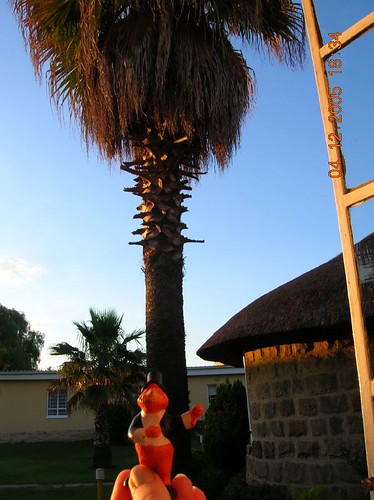
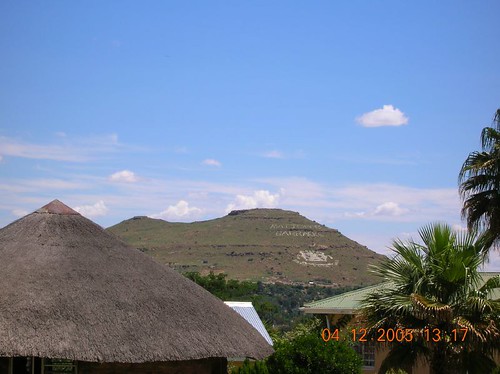
Youpi au/in Maseru (Lesotho)

Youpi a pris le temps de s'eloigner de ses obligations professionnelles pour m'accompagner au Lesotho, un petit pays enclave au coeur de l'Afrique du Sud.

Youpi took the time to leave his professionnal obligations to join me in Lesotho, a small enclaved country at the heart of South Africa.


The Beaver

My guest map is wonderful ! And you'd all be wonderful to post, all of you lurk mode readers!Thanks and may the winds of Fate blow your way !

Lesotho, The Mountain Kingdom / Royaume des Montagnes

Quelques details historiques sur le Lesotho, un petit pays que je visite brievement cette semaine.

- XVIème siècle : arrivée des Sotho dans cette partie de l'Afrique alors peuplée de quelques autres ethnies avec qui ils se mélangèrent.
- début XIXème siècle : Arrivée des premiers commerçants blancs dans la région (appelée désormais Basutoland).
- 1820 : le roi Moshoeshoe, afin de lutter contre les raids zoulou, unifie les tribus sotho.
- 1840-68 : lutte des Sotho contre les Boers (colons d'origine néerlandaise d'Afrique du Sud) qui veulent s'approprier leurs terres.
- 1868 : afin de se protéger des Boers, Moshoeshoe demande l'aide des Anglais qui établissent un protectorat sur le territoire.
- 1899-1902 : guerre des Boers et victoire anglaise en Afrique du Sud.
- début-mi XXème siècle : malgré la création de l'Union Sud-Africaine en 1910 et de la république d'Afrique du Sud en 1961, le Basutoland (Lesotho) demeure à part sous contrôle britannique.
- 1966 : le pays devient indépendant dans le cadre du Commonwealth sous le nom de Lesotho.
- 1970 : perte du pouvoir par le roi qui de fait n'occupe plus qu'un poste honorifique au profit de son Premier ministre.
- 1986 : coup d'état militaire qui redonne ses pouvoirs au roi.
- 1993 : après une période mouvementée, retour des civils à la tête du pays.
- 1998 : début de guerre civile suite à des élections contestées et intervention de l'Afrique du Sud qui rétablit plus ou moins le calme.

Courtoisie de Africa On Web

Some historical detail about Lesotho, the small country I am briefly visiting this week.

San (Bushmen), who were the region's earliest known inhabitants, were supplanted several centuries prior to colonization by various Bantu-speaking peoples, including those that came to be the Sotho and the Zulu. The Sotho are made up of remnants of ethnic groups that were scattered during the disturbances accompanying the rise of the Zulu (1816-30).

They were rallied c.1820 by Moshoeshoe , a commoner who founded a dynasty in what is now Lesotho. Moshoeshoe not only defended his people from Zulu raids but preserved their independence against Boer and British interlopers. He also welcomed Catholic and Protestant missionaries.

Following wars with the Boer-ruled Orange Free State in 1858 and 1865, Moshoeshoe put the Sotho under British protection (1868), establishing the protectorate of Basutoland. The protectorate was annexed to Cape Colony in 1871 without Sotho consent, but in 1884 it was placed under the direct control of Britain.

When the Union of South Africa was forged in 1910, Basutoland came under the jurisdiction of the British High Commissioner in South Africa. Provisions were made for the eventual incorporation of the territory into the union, but Sotho opposition, especially after the rise of the Nationalist party with its apartheid policy, prevented annexation.

In 1960 the British granted Basutoland a new constitution that paved the way to internal self-government. On Oct. 4, 1966, Basutoland became independent as Lesotho. Following general elections in early 1970, which the opposition Basutoland Congress party (later the Basotho Congress party; BCP) apparently won, Prime Minister Leabua Jonathan declared a state of emergency and suspended the constitution.

King Moshoeshoe II went into exile but returned at the end of the year, thereafter serving largely as a figurehead. In 1973 an interim assembly began work on a new constitution, but the BCP, led by Ntsu Mokhehle, refused to participate. In Jan., 1974, Jonathan accused the BCP of attempting to stage a coup; the party was outlawed and hundreds of its members reportedly killed.

Armed clashes between the Lesotho Liberation Army (the militarized segment of the BCP) and the government were common throughout the 1970s and 80s. In the late 1970s, Jonathan exploited growing popular resentment of South Africa and its policies of apartheid. South Africa responded by organizing economic blockades and military raids against Lesotho. Maj. Gen. Justinus Lekhanya led a coup in 1986 that installed King Moshoeshoe II as head of state. After prolonged disputes with Lekhanya over power, the king went into exile.

In 1990, Moshoeshe II's son, Letsie III, became king but was reduced to a purely ceremonial role. Lekhanya was overthrown (1991) in a bloodless coup, and Col. Elias Tutsoane Ramaena came to power as chairman of a six-member military council. A free election in 1993, the first in 23 years, resulted in a BCP landslide, and Ntsu Mokhehle became prime minister. In 1994 fighting between two rival army factions unsettled the young democracy; the king ousted Mokhehle but was pressured by other S African nations to reinstate him.

In Jan., 1995, Letsie abdicated in favor of his father, Moshoeshoe II. After Moshoeshoe was killed in an automobile accident in Jan., 1996, Letsie was restored to the throne. In 1997, Mokhehle remained prime minister as he broke from the BCP and founded the Lesotho Congress for Democracy party (LCD), reducing the BCP to the opposition. Mokhehle died in Jan., 1998; new elections were called in May, and Pakalitha Mosisili of the LCD secured the prime ministership. Demonstrators charging election fraud staged violent protests in Maseru, causing severe damage.

In Sept., 1998, South Africa and Botswana sent troops into the country to restore order, and in Oct. the government and the opposition agreed to form a transitional body to organize new elections within 18 months. Elections were held in May, 2002, under a revamped electoral system designed to increase opposition representation in the parliament. The LCD again won the elections. The effects of a three-year drought led Prime Minister Mosisili to appeal for international food aid in early 2004.

Courtosy of Encyclopedia.com

December 03, 2005

Travelling Beaver Advice / Conseils du Castor Voyageur

Pour les nouveaux lecteurs, je dois clarifier que je ne vis pas en Afrique du Sud. Je travaille comme Auditeur Interne (on nous appelle la "Paper Police") pour une agence de developpement internationale. Dans le cadre de mon travail je suis appeler a voyager 100% du temps, des missions de 6 a 8 semaines bout a bout. Je suis en ce moment en train d'auditer notre programme en Afrique du Sud, mais je quitte le 16 decembre pour les fetes a Mtl. Je ne retourne pas en Afrique du Sud en Janvier.

For new readers, I must clarify that I do not live in South Africa. I am an Internal Auditor (some call us “the Paper Police”) for an international development agency. For my work, I have to travel 100% of the time, which involves missions lasting 6 to 8 weeks. I am presently auditing our South-African activities, but I will leave on December 16th to go spend the holidays in Montreal. I am not returning to South Africa in January.

Toutefois, si j'avais quelque conseil a donner aux voyageurs curieux de visiter l’Afrique du Sud, je dirai:

However, if I had any advice to give travelers interested in South Africa, I would say :

- Prevoyez de passer une journee complete a Soweto: entre la maison de Nelson Mandela, l'Eglise Regina Mundi, et le Hector Peterson Memorial, il y a assez a voir et a faire pour combler une journee commencant a 7h le matin.

- Plan for a whole day in Soweto: with Nelson Mandela’s house, Regina Mundi church, and the Hector Peterson Memorial, there is enough to see and do to fill a day starting a 7AM.

- Si vous restez a Johannesburg, Sandton reste l'endroit le plus securitaire. Le taux de criminalite est tres haut, et les femmes sont particulierement la cible de viols a Jo-Burg. Si on combine ce riqsque au taux de prevalence du VIH-SIDA (presque 30%), ca fait peur.

- If you stay in Jo-Burg, Sandton remains the safest area. The crime rate is very high, and women particularly are the target of rape in Jo-Burg. This, combined to the HIV-AIDS prevalence rate (almost 30%) is very scary.

- Ne marchez pas seul après le coucher du Soleil.

- Do not walk outside alone after sunset.

- Donnez-vous une journee pour visiter l'Apartheid Museum.

- Do plan a day to visit the Apartheid Museum.

- Prevoyez une journee pour l'Africa Museum. Ce musee est situe a Newtown, il ya en face un resto tres sympa ou on joue du Jazz Live le samedi soir. La soiree Jazz, c’est a faire absolument, c'est vraiment tres tres sympa. L'Africa Musem est gratuit et absolument immense. Arrivez tot pour ne pas etre frustres de partir. Il y a aussi juste a cote les theatres ou on joue des comedies musicales sud-africaines (noires). Je n'ai pas eu l'occasion d'y aller mais c'est tres bien parait-il.

- Plan a day to visit the Africa Museum. This museum is in Newtown, and right across the street is a fun restaurant where live Jazz is played on Saturday nights. The Jazz evening is a must, it’s a lot of fun. The Africa Museum is free and absolutely huge. Get there early to avoid being frustrated from leaving. Right next door, there are the Theaters where South-African musicals are presented. I didn’t have the chance of going, but I’m told it’s worth it.

- Il serait une bonne idee de passer votre permis international avant de partir. A Jo-Burg, les distances sont longues et les taxis coutent plus cher que de louer une voiture. Par contre, il ne faut pas oublier : en SA, on conduit du cote croche de la route (et non du cote droit) !

- It’s a good idea to have an international permit. In Jo-Burg, distances are long and taxis are more costly then car rentals. Don't forget that people here drive on the wrong side of the road (on not on the right one) !

- Si vous avez des appareils electriques, prevoyez un transfo ou un adapteur comme pour la France. Les prises sont a trois trous mais on peut facilement trouver un adapteur sur place.

- If you have electrical appliances, do plan to have a transformator or adaptor as you would for France. Plugs have 3 pins here, but one can easily find an adaptor for French pins.

- C'est une bonne idee d'apprendre un minimum de langue africaine - le Zulu, Xhosa, Shona et Sutu sont repandus. Ca nous permet de bien nous integrer au Sud-Af noirs.

- It’s a good idea to learn a minimum of African idiom – Zulu, Xhosa, Shona and Sutu are common. This allows us to integrate well with the local black south-africans.

Zulu (J-Burg):
Sawubona = bonjour/Good morning ;
Kunjanie = Ca va?/How are you ;
Njaiapila = ca va bien / I’m doing well ;
Guiabanga = Merci / Thank you.

Sotho (Lesotho):
Me = Madame / Madam
Mtate = Monsieur / Sir
Quialeboa = Merci / Thank you
Ahholo = beaucoup / a lot of.

Afrikaans (Afrikaner):
Danki = merci / Thank you
Plaisir = bienvenue / Welcome.

- En Afrique du Sud, on peut trouver a peu pres n'importe quoi. Pas la peine de s'encombrer de shampoings, etc.

- In SA, one can find about anything. No need to cumber oneself with shampoo etc.

Si vous avez le temps, prevoyez quelques jours au Lesotho (100$ d'avion de Jo-Burg et pas de visa requis pour les ressortissants du Commonwealth ou les Americains). Le paysage est a couper le souffle et les attractions sont plutot hors de l'ordinaire (traces de dinosaures et peintures rupestres entre autres).

If you have time, plan a few days in Lesotho (100USD for an airplane from Jo-Burg, and no visa needed for Commonwealth or American citizens). The landscap is breath taking, and the attractions are out of the ordinary (dinosaur footsteps and cave paintings, amongst others).


The Beaver


Thanks, Kingston Girl,for giving me a link!

My guest map is wonderful ! And you'd all be wonderful to post, all of you lurk mode readers!
Thanks and may the winds of Fate blow your way !